Special offers: free digital logo mock-up and free samples against a confirmed LPO. View offers


Checklist: Winter vs Summer Uniform Planning in the UAE

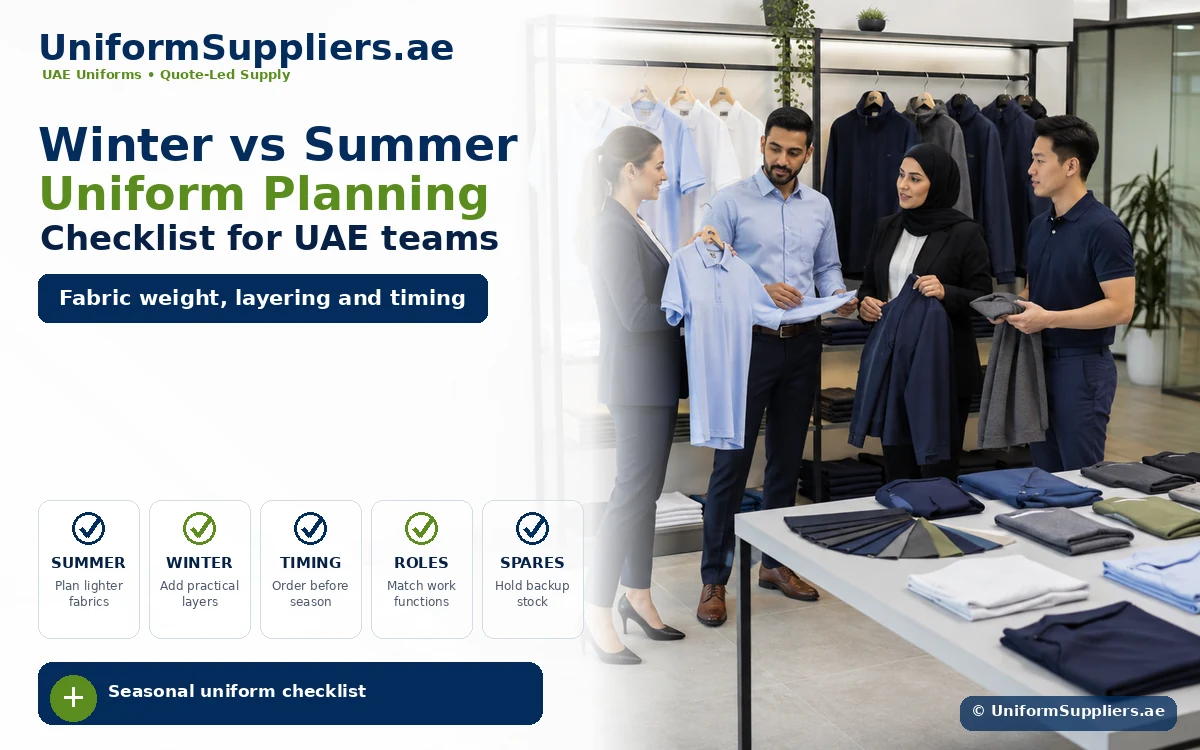
Seasonal uniform planning in the UAE is less about temperature extremes and more about timing — knowing when to order, when to introduce a layering option, and when to stop assuming last year’s ordering calendar still applies. UAE “winter” is a mild, cooler season rather than a cold one, and treating it as anything more dramatic leads to over-ordering heavy layers that sit unused most of the season.
This checklist-style guide focuses purely on the ordering and planning timeline for seasonal uniform needs — not fabric science, which our guide to fabrics for UAE climate covers in detail. Use that guide to choose the fabric itself, and this one to plan when to order it.
What this guide covers
- What “winter” actually means in the UAE
- A seasonal planning calendar
- Deciding whether you need a layering option at all
- Ordering ahead of the season, not during it
- Planning for indoor and outdoor teams differently
- Storing and reissuing seasonal layers year to year
- Budgeting for a seasonal layer as a planned cost
- Communicating the seasonal option to staff
- Seasonal planning checklist
- Frequently asked questions
What “winter” actually means in the UAE
The UAE’s cooler season, roughly November through March, brings milder daytime temperatures and noticeably cooler mornings and evenings, particularly inland and away from the coast — not the cold, snow-affected winter conditions common in many other markets. Planning a UAE uniform programme around imagery of a “cold winter” leads to over-specifying heavy insulated layers that are uncomfortable and unnecessary for most of the season and most roles.
The practical seasonal need in the UAE is usually a lighter layering option for early mornings, evenings, and air-conditioned indoor environments that can feel cold by contrast with the mild outdoor temperature — not a genuinely cold-weather uniform programme.
A seasonal planning calendar
Ordering a seasonal layer during the season itself — once staff are already commenting on cold mornings — puts you behind on lead time and often means settling for whatever is quickest to produce rather than what best matches your uniform programme. Planning and ordering any seasonal layering option before the cooler season begins, generally by early autumn, gives your supplier time to produce and deliver before the layer is actually needed.
Working backward from when the layer needs to be in staff hands, rather than forward from when planning conversations happen to start, is the most reliable way to avoid a seasonal order becoming a rushed, reactive purchase.
Deciding whether you need a layering option at all
Not every UAE workforce needs a seasonal layering option. Indoor, consistently air-conditioned roles may see little practical benefit from a seasonal layer, while outdoor or semi-outdoor roles, and roles moving frequently between strongly air-conditioned interiors and outdoor heat, are more likely to benefit from a light layering option during cooler mornings and evenings.
Rather than introducing a seasonal layer as a blanket policy, it is worth reviewing which roles genuinely experience a noticeable seasonal temperature swing in their actual working environment, and scoping the layering option to those roles specifically.
Ordering ahead of the season, not during it
A seasonal layering item — typically a lightweight fleece, a soft-shell jacket, or a similar light outer layer — should be planned on the same specification and ordering timeline as any other uniform item: confirm the specification, confirm sizing, and place the order with enough lead time for production and delivery before it is needed. Final lead time is confirmed during quotation and depends on the specific garment and quantity, so beginning this process early in autumn rather than waiting for the first cool week is the safest approach.
For organisations introducing a seasonal layer for the first time, treat it as a new specification decision requiring the same sampling and approval process as any other new garment, rather than a quick add-on to an existing order.
Planning for indoor and outdoor teams differently
A single organisation often has both indoor and outdoor or field-based teams, and a single seasonal layering decision rarely suits both equally well. Indoor teams affected mainly by strong air conditioning may need only a lightweight layer for comfort at a desk, while outdoor or site-based teams may need a more substantial layer for early-morning or evening work in the cooler season.
Scoping the seasonal layer by role rather than issuing one standard item across the whole organisation avoids both under-provisioning field teams and over-provisioning desk-based teams with a heavier layer they rarely need.
Storing and reissuing seasonal layers year to year
Unlike core uniform items worn year-round, a seasonal layer is used for a few months a year and then stored, which raises a practical question of whether to reissue existing stock each year or reorder fresh each season. Keeping the approved seasonal specification as a stored repeat-order record means a reorder for new hires or replacement stock can reference the same design and fabric without restarting the specification process each autumn.
Where staff store their own seasonal layer between uses rather than returning it to a central store, a brief reminder ahead of the season to check condition and request a replacement if needed helps avoid a rush of replacement requests once the cooler weather has already arrived.
Reviewing seasonal needs annually
A seasonal layering programme is worth a brief annual review rather than treating the original specification as permanently fixed. Feedback from staff on whether the layer was used, whether it suited the actual temperature swing experienced, and whether quantities matched headcount changes over the year all inform whether the following season’s order should stay the same or be adjusted.
This is a lighter-touch review than a full uniform programme audit — a short conversation with a few team representatives ahead of the ordering window is usually enough to catch any meaningful adjustment needed before placing the next seasonal order.
Budgeting for a seasonal layer as a planned cost
A seasonal layer is easiest to budget for when it is planned as a known, recurring annual line item rather than an unplanned request that surfaces once staff start asking for something warmer. Treating it the same way as any other recurring uniform cost — reviewed and budgeted alongside the main uniform programme rather than as a separate, ad hoc purchase — avoids it competing for urgent, unbudgeted approval once the cooler season has already begun.
For organisations working through a formal quotation and purchase order process, requesting the seasonal layer quotation at the same time as any other planned annual uniform costs, rather than as a separate mid-year request, keeps procurement timing consistent and predictable.
Communicating the seasonal option to staff
Staff are more likely to use a seasonal layering option consistently, rather than bringing in their own outerwear, if they know it exists and how to request it before the cooler season begins. A short internal note ahead of the season — confirming what the layer is, who it applies to, and how to request one if theirs is missing or needs replacing — reduces both under-use of an approved item and inconsistent, off-brand outerwear appearing on-site during cooler months.
This is particularly worth doing for newer staff who joined outside the previous cooler season and may not know a seasonal option is available at all, since without a specific prompt they are the most likely group to default to their own personal jacket instead.
Seasonal planning checklist
| Step | Timing |
|---|---|
| Review which roles genuinely need a seasonal layer | Once, then annually reviewed |
| Confirm specification and request samples | Late summer, before the cooler season |
| Confirm sizing and place the order | Early autumn, allowing full lead time |
| Distribute layers to relevant teams | Before the cooler season begins |
| Collect feedback for next year’s order | End of the cooler season |
Mustang recommendation: scope any seasonal layering option to the roles that genuinely experience a temperature swing rather than issuing it organisation-wide, and begin the ordering process in late summer so the layer is in staff hands before the cooler season starts, not partway through it.
Frequently asked questions
How cold does it actually get in the UAE in winter?
The UAE’s cooler season is mild rather than cold, with noticeably cooler mornings and evenings, particularly inland. It is not a snow-affected or genuinely cold winter, so uniform planning should reflect a light layering need rather than a heavy cold-weather programme.
When should we start ordering seasonal uniform layers?
In late summer, ahead of the cooler season, allowing full lead time for specification, sampling and production before the layer is actually needed by staff.
Does every role need a seasonal layering option?
No. Indoor, consistently air-conditioned roles often see little benefit, while outdoor or field-based roles, and roles moving between strong air conditioning and outdoor heat, are more likely to benefit from a light layer.
What kind of garment usually works as a UAE seasonal layer?
A lightweight fleece or soft-shell jacket typically suits UAE conditions better than a heavy insulated coat, which is rarely needed given the mild nature of the cooler season.
Should we reissue the same seasonal layer each year or reorder fresh?
Either approach can work — what matters is keeping the approved specification on file as a stored repeat-order record so replacement or new-hire orders reference the same design without restarting the process each season.
How should we plan for teams with both indoor and outdoor roles?
Scope the seasonal layer by role rather than issuing one standard item organisation-wide, since indoor and outdoor teams typically experience the seasonal temperature swing very differently.
Should we review our seasonal uniform plan every year?
A brief annual review, checking staff feedback and headcount changes, is worth doing before placing the next season’s order, even if the specification itself does not change.
Ready to plan your seasonal uniform layer for this year? Request a quote from Uniform Suppliers UAE.