Special offers: free digital logo mock-up and free samples against a confirmed LPO. View offers

Retail Staff Uniforms: A Complete UAE Guide to Branding Your Frontline Team

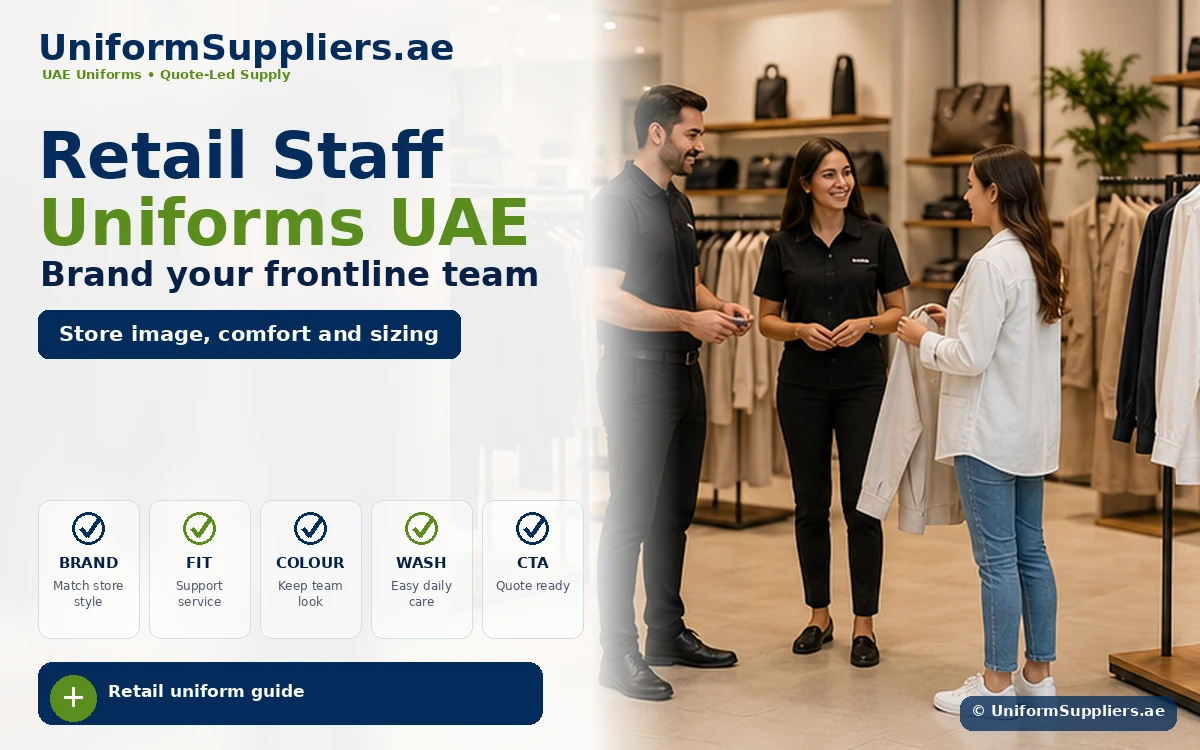
Retail is one of the few environments where the uniform is doing marketing, service and security work at the same time. A shopper should be able to spot a staff member from across the store, the uniform should hold up through a full shift of restocking and standing, and it needs to feel consistent whether the store is in a mall in Dubai or a strip location in Sharjah. Retail also tends to run leaner margins on uniform spend than corporate head-office roles, so getting the brief right the first time matters more than in almost any other sector.
This guide covers what UAE retail operators — from single boutiques to multi-branch chains — typically need to think through when building or refreshing a frontline uniform programme.
In this guide
- Why retail uniforms are a different brief to office wear
- Core pieces in a retail uniform kit
- Fabric and comfort for a standing, moving role
- Branding retail uniforms without looking like a costume
- Keeping a look consistent across multiple stores
- Seasonal and mall-climate considerations
- Retail uniform planning checklist
- FAQ
Why retail uniforms are a different brief to office wear
A corporate office uniform is largely about looking professional while seated at a desk for much of the day. A retail uniform has to survive constant movement — reaching shelves, kneeling to restock lower displays, standing for long stretches, and frequent customer-facing interaction — while still reading as smart and on-brand under mall or showroom lighting. It also needs to be easy to replace and reorder quickly, since retail has higher staff turnover than most office-based roles, and a new hire often needs to be uniformed within their first few days.
Core pieces in a retail uniform kit
Most UAE retail uniform kits are built from a small set of interchangeable pieces rather than a single fixed outfit, which keeps the programme flexible as ranges and seasons change:
- Branded polo shirts or corporate shirts — the most common base layer, easy to launder and reorder individually.
- Branded aprons or tabards — useful for stockroom-heavy roles or where staff need pockets for handheld scanners and till accessories, and can be worn over personal or seasonal clothing.
- Name badges or ID cards — important for customer trust and quick identification of staff on the floor.
- Branded caps or headwear — common for outlet, kiosk and F&B-adjacent retail formats.
- Outerwear layers — a branded jacket or knitwear piece for mall environments that run cold air conditioning, especially relevant given how aggressively UAE malls cool their retail floors.
Fabric and comfort for a standing, moving role
Retail staff are typically on their feet for a full shift, moving between a cool, air-conditioned shop floor and a warmer stockroom or loading area. A breathable, easy-care fabric that doesn’t crease after an hour of movement performs better here than a stiffer corporate fabric that looks sharp for the first hour and creased by midday. Poly-cotton and performance polyester blends are common choices for exactly this reason — they hold shape, resist visible sweat marks under bright retail lighting, and tolerate frequent washing without losing colour quickly.
Branding retail uniforms without looking like a costume
The line between “branded and recognisable” and “looks like a costume” is a common concern for retail brand teams, particularly in fashion, beauty and lifestyle retail where the uniform sits close to the product being sold. A few approaches that tend to work well:
- Keep logo placement to one or two clean points — chest and sleeve, for example — rather than covering the garment.
- Use embroidery for a more premium, understated look on polos and shirts; use print for higher-contrast, high-visibility branding like event or promotional pop-up staff.
- Let the uniform take cues from the retail brand’s own colour palette rather than a generic corporate scheme, so it reads as an extension of the store rather than an unrelated uniform.
See our comparison of embroidery vs printing for more detail on which method suits which retail application.
Keeping a look consistent across multiple stores
For chains operating several locations across the UAE, the biggest practical challenge is usually not the design — it’s keeping every branch supplied with the same fabric, colour batch and sizing standard as new stores open or staff rotate between locations. A few habits help:
- Centralise ordering through one point of contact rather than letting individual store managers order independently, which avoids colour and fabric-batch drift over time.
- Keep a simple size run reference on file so reorders match the original sizing standard.
- Standardise on a small number of core SKUs (one shirt style, one apron style, one cap style) rather than allowing store-by-store variation, which simplifies reordering and keeps the brand consistent to shoppers moving between branches.
Seasonal and mall-climate considerations
UAE retail environments vary more in temperature than staff often expect — outdoor kiosks and market stalls face full summer heat, while mall interiors are frequently over-cooled. Building in one layering option (a branded knit or light jacket) alongside the core uniform means staff aren’t left choosing between comfort and looking uniform, which matters most during the handover between an outdoor delivery task and a shift back on an air-conditioned floor.
Planning reorders around retail staff turnover
Retail has a higher staff turnover rate than most office-based sectors, and a uniform programme that isn’t built with this in mind quickly becomes a source of ongoing friction — new hires waiting for uniforms, mismatched sizing between old and new stock, or managers ordering single pieces ad hoc at a higher cost and slower turnaround than a planned reorder. Building a simple reorder rhythm — checking stock levels monthly, keeping a small buffer of common sizes on hand, and reordering core pieces before they run out rather than after — keeps new hires uniformed quickly without each order becoming an emergency.
For chains with predictable hiring patterns, for example around seasonal peaks like back-to-school or holiday retail periods, planning uniform reorders ahead of the hiring spike avoids the scramble that happens when uniform ordering is only triggered reactively once new staff have already started.
Uniform standards as part of staff training
A well-designed uniform only delivers its full brand value if it’s worn correctly and consistently, which means uniform standards are worth including in new-hire training rather than assumed to be self-explanatory. A short briefing — which pieces are required, how the uniform should be worn, grooming expectations that go alongside it, and who to contact for sizing issues or replacements — takes a few minutes and prevents a lot of inconsistency across a shop floor, particularly in multi-branch chains where store managers may otherwise interpret the standard differently.
Retail uniform planning checklist
| Consideration | What to decide |
|---|---|
| Core pieces | Shirt/polo, apron or tabard, headwear, outerwear layer |
| Fabric | Breathable, easy-care, colour-stable under retail lighting |
| Branding method | Embroidery for premium look, print for high-visibility roles |
| Sizing standard | Documented size run kept on file for consistent reorders |
| Ordering process | Centralised point of contact across all branches |
| Seasonal layer | One outerwear or knitwear option for mall air conditioning |
| New-hire turnaround | Simple reorder path so new staff are uniformed quickly |
Handing the brief to your uniform supplier
When briefing a supplier on a retail uniform programme, it helps to bring more than just a logo file. Sharing your store’s colour palette, the environments staff work in (indoor mall, outdoor kiosk, stockroom-heavy or till-focused), your typical staff turnover rate, and how many branches the programme needs to cover gives a supplier enough context to recommend the right fabric, branding method and reorder structure from the start, rather than working through several rounds of revisions to get there.
FAQ
How many uniform sets does a retail employee usually need?
Most operators issue more than one set per employee so a spare is always available while one is being laundered, particularly for daily customer-facing roles. The right number depends on wash frequency and shift pattern, and is best confirmed during quotation based on your rota.
Can retail uniforms be updated seasonally without a full redesign?
Yes — many retail programmes keep a consistent core (shirt, apron, badge) and add or remove a seasonal layer such as a jacket or knitwear piece, which avoids redesigning the full kit each season.
What’s the best branding method for a retail apron?
Embroidery tends to hold up better than print on garments that see heavy daily wear and washing, such as aprons and tabards, because it doesn’t crack or peel with repeated laundering.
How do we keep sizing consistent when reordering for new hires?
Keeping a size run reference from the original order — and reordering against that same reference rather than re-measuring from scratch each time — is the simplest way to avoid fit drift between original and reorder stock.
Can uniform pieces be mixed and matched across departments in one store?
Yes, this is common — for example, a shared shirt style across the shop floor with a different apron or badge colour to distinguish stockroom, till or supervisor roles within the same store.
How should retail uniform budgets account for high staff turnover?
Building a small ongoing reorder allowance into the annual uniform budget, rather than treating every reorder as an unplanned cost, makes turnover-driven reordering easier to manage and forecast year to year.
Should seasonal or pop-up retail staff get a different uniform standard?
Many retailers use a simplified version of the core uniform — a branded T-shirt or apron rather than the full kit — for short-term seasonal or event staff, which keeps costs proportionate to the length of the engagement while still presenting a consistent branded look.
Build a retail uniform programme that scales with you
Whether you’re outfitting a single boutique or a multi-branch chain, we can help you build a uniform kit that’s practical for a moving, customer-facing role and consistent across every location. Read more in our corporate uniforms guide or see our related multi-branch retail checklist. Request a quote or request a sample to get started.