Special offers: free digital logo mock-up and free samples against a confirmed LPO. View offers


FAQ: Corporate Uniform Programmes for SMEs

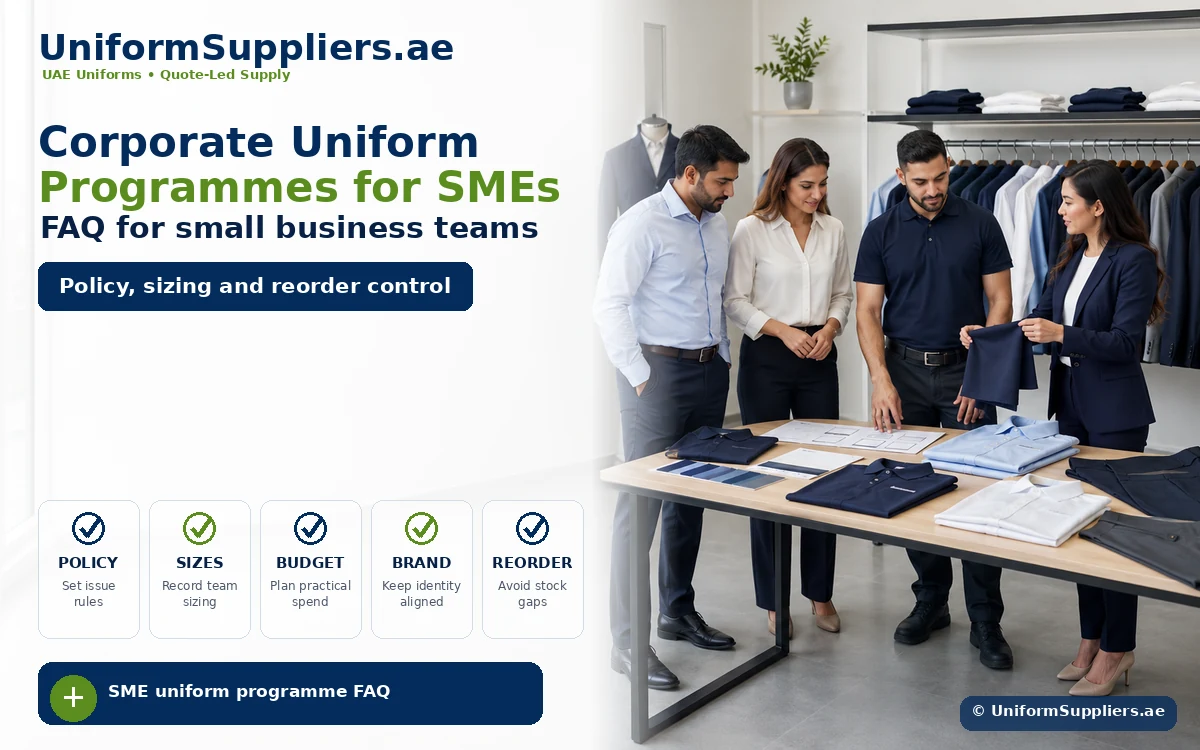
A growing UAE business often reaches a point where “let staff wear whatever, plus a branded polo for the odd event” no longer feels right. Customers, suppliers or new hires start noticing the gap between a professional operation and an inconsistent look on the floor or at the front desk.
Setting up a first proper uniform programme raises a lot of practical questions for a small or medium-sized business: how is this different from what a large enterprise does, where do we start, how do quantities work, and what happens once the first order is done and staff numbers keep changing.
This FAQ-style guide answers those questions directly, in the order an SME buyer in the UAE typically asks them, and closes with a dedicated FAQ section covering the details that come up once a programme is already underway.
What this guide covers
- How an SME uniform programme differs from an enterprise rollout
- Getting started: the first steps
- How order quantities and minimums work, in general terms
- Phasing a rollout as the business grows
- How repeat ordering works once specification is on file
- SME decision checklist
- Working with Uniform Suppliers UAE
- Frequently asked questions
How an SME uniform programme differs from an enterprise rollout
An enterprise uniform programme typically involves a dedicated procurement function, a formal tender, multiple departments and a specification document that goes through several rounds of sign-off. An SME programme covers the same ground — specification, sizing, ordering, replenishment — but with fewer people involved and decisions usually made by one owner, manager or HR contact.
Scale, not standards
The difference is scale, not quality. A small business can still expect a clear specification, a proper size chart and a considered fabric choice; it simply moves through those steps faster because there is no multi-department sign-off chain. Fit, branding accuracy and fabric suitability for the UAE climate matter just as much for a ten-person team as for a two-hundred-person one.
Budget and phasing flexibility
SMEs are also more likely to phase spending — ordering front-of-house staff first, or one department before another — rather than committing the whole team at once. A supplier used to working with smaller businesses will plan the specification and sizing process so that this kind of phased ordering is straightforward rather than something worked around after the fact.
Getting started: the first steps
The starting point for any SME uniform programme is the same, regardless of team size: decide what the uniform needs to communicate, then translate that into a specification the whole team can be measured and ordered against.
Step 1 — Define the look and the priority items
List the roles that need uniforms and the garment types each one needs — for example, a polo and trousers for front-of-house, a chef coat for the kitchen, or a branded jacket for delivery staff. Decide which of these is the priority for the first order.
Step 2 — Choose fabric and branding method
Pick a fabric weight and finish suited to the role and the UAE climate — breathable, colour-stable fabric for outdoor or front-of-house work, easy-care fabric for kitchen or back-of-house roles — and decide between embroidery, screen printing, heat transfer or sublimation for the logo, based on the garment and the level of detail in the logo.
Step 3 — Get sizing and a sample
Collect sizes using a standard chart, or take advantage of free onsite individual measurement in the UAE for qualifying company orders, which removes the guesswork for a small team. Request a sample against a confirmed LPO before committing to the full run, so fit and branding placement can be checked on an actual garment.
Step 4 — Confirm the order
Once the sample is approved, confirm quantities per size and issue the LPO. From this point, the approved specification is kept on file, which is what makes every future order faster than the first one.
How order quantities and minimums work, in general terms
Custom uniform manufacturing generally involves a minimum order quantity, because cutting fabric and setting up embroidery or print for a small run has a fixed cost regardless of how many garments are produced. Ready-stock items, by contrast, are typically available in smaller quantities because they are already produced and held in inventory rather than made to order.
For an SME that does not yet have the volume to justify a fully custom minimum on every item, a practical approach is to combine ready-stock garments — for items where a good generic fit and finish is available — with custom manufacturing for the pieces that need an exact brand match, such as a front-of-house shirt with a specific logo placement. Exact minimum quantities and any applicable thresholds are confirmed during quotation, since they depend on the garment, fabric and branding method chosen.
This mixed approach is one of the reasons a single uniform programme that offers both ready-stock and custom manufacturing suits SMEs particularly well: it allows a small business to start with what is available quickly and add fully custom pieces as volume and budget allow.
Phasing a rollout as the business grows
Very few SMEs need to uniform the entire team on day one, and trying to do so can strain both budget and sizing logistics. A phased approach lets the business start with the highest-impact roles and add the rest as headcount, budget or new locations justify it.
- Phase the roles, not just the quantity. Start with the team customers actually see — front-of-house, delivery, reception — before extending to back-of-house or seasonal roles.
- Use ready stock to bridge gaps. Urgent ready-stock supply can cover new hires or a sudden gap while a custom batch is still in production, so the programme does not stall waiting on one delivery.
- Add garment types over time. A first order might cover shirts only; jackets, aprons or outerwear can be added in a second phase once the core look is settled.
- Expand by location if the business has more than one site. A single specification can be issued to a second branch or site as it opens, rather than designing a new uniform from scratch each time.
How repeat ordering works once specification is on file
The real value of a proper uniform programme shows up at the second order, not the first. Once a specification — fabric, colour, logo placement, sizing — has been approved and produced once, it is kept as a stored repeat-order specification record, so a new hire, a replacement garment or a top-up order can reference that record directly instead of restarting the design and sampling process.
In practice this means a manager can request a repeat order by simply confirming quantities and sizes against the file on record, without needing to re-approve fabric, colour or logo placement each time. This is particularly useful for an SME with steady but unpredictable turnover, where new-hire uniforms need to be ordered in small batches throughout the year rather than in one annual bulk order.
It is worth confirming with the supplier, at the time the first order is placed, that specification records will be retained and referenced for future orders — this is standard practice with an established uniform partner and saves considerable time on every order after the first.
SME decision checklist
Before placing a first uniform order, an SME buyer can work through this short checklist to make sure nothing important is skipped.
| Decision | What to confirm |
|---|---|
| Which roles need uniforms first | Prioritise customer-facing or safety-relevant roles for the first order |
| Ready stock, custom, or both | Match each garment type to the option that suits the required branding accuracy and timeline |
| Fabric and finish | Choose weight and finish suited to the role and UAE climate, not just appearance |
| Branding method | Confirm embroidery, print, heat transfer or sublimation suits the logo and garment |
| Sizing method | Decide between a standard chart, self-reported sizing, or free onsite measurement |
| Sample approval | Request a sample against a confirmed LPO before the full run is produced |
| Specification records | Confirm the approved specification will be kept on file for repeat orders |
Working with Uniform Suppliers UAE
Uniform Suppliers UAE, the uniform division of Mustang Advertising Trading LLC, has supplied uniforms from Dubai since October 2007, with production and warehouse operations in Dubai, including Al Qusais Industrial Area, and additional storage in Sharjah. For a business exploring uniforms for the first time, the Uniform Manufacturer in UAE pillar page is a useful starting point for understanding the range of services available.
Because SMEs often need both fast availability and an exact brand match, the programme combines ready-stock uniforms with custom uniform manufacturing in a single order, with employee-by-employee packing so garments arrive ready to distribute rather than needing to be sorted on-site. For a fuller look at building out the programme over time, see the guide to building an employee uniform programme.
To start a first order or talk through which garments to prioritise, request a quote with an outline of the roles, approximate headcount and any existing branding assets.
Frequently asked questions
Is a formal uniform programme worth setting up for a small team?
Yes, even a small team benefits from a written specification, a consistent size chart and stored records, because it makes every future order — including single new-hire replacements — faster and more consistent than reordering from scratch each time.
Do we have to order a large quantity to get started?
Not necessarily. Ready-stock items are generally available in smaller quantities than fully custom production, and a mixed programme lets an SME start with ready stock for some items and add custom-branded pieces as volume grows. Exact quantities and any thresholds are confirmed during quotation.
Can we order for one department first and the rest later?
Yes. Phasing by role or department — starting with customer-facing staff — is a common approach for SMEs and does not require re-approving the specification each time, provided the same fabric, colour and branding rules are kept consistent across phases.
What happens when we hire new staff after the main order is complete?
Because the approved specification is kept as a stored repeat-order record, a new hire’s uniform can usually be ordered by simply confirming size and quantity, without repeating the sampling and approval process from the first order.
Should we choose ready-stock or custom-branded uniforms?
It depends on the role and how important exact brand matching is. Ready stock suits items where a good generic fit is acceptable and speed matters; custom manufacturing suits garments where logo placement, colour matching or a specific cut is important. Many SMEs use both within one programme.
How do we make sure sizing is accurate for a small, spread-out team?
A standard size chart with self-reported measurements works for many small teams, and free onsite individual measurement is available in the UAE for qualifying company orders where a more accurate fit is needed, particularly for front-of-house or uniformed roles.