Special offers: free digital logo mock-up and free samples against a confirmed LPO. View offers
Engraved Badges: A Durable Way to Brand Your Team

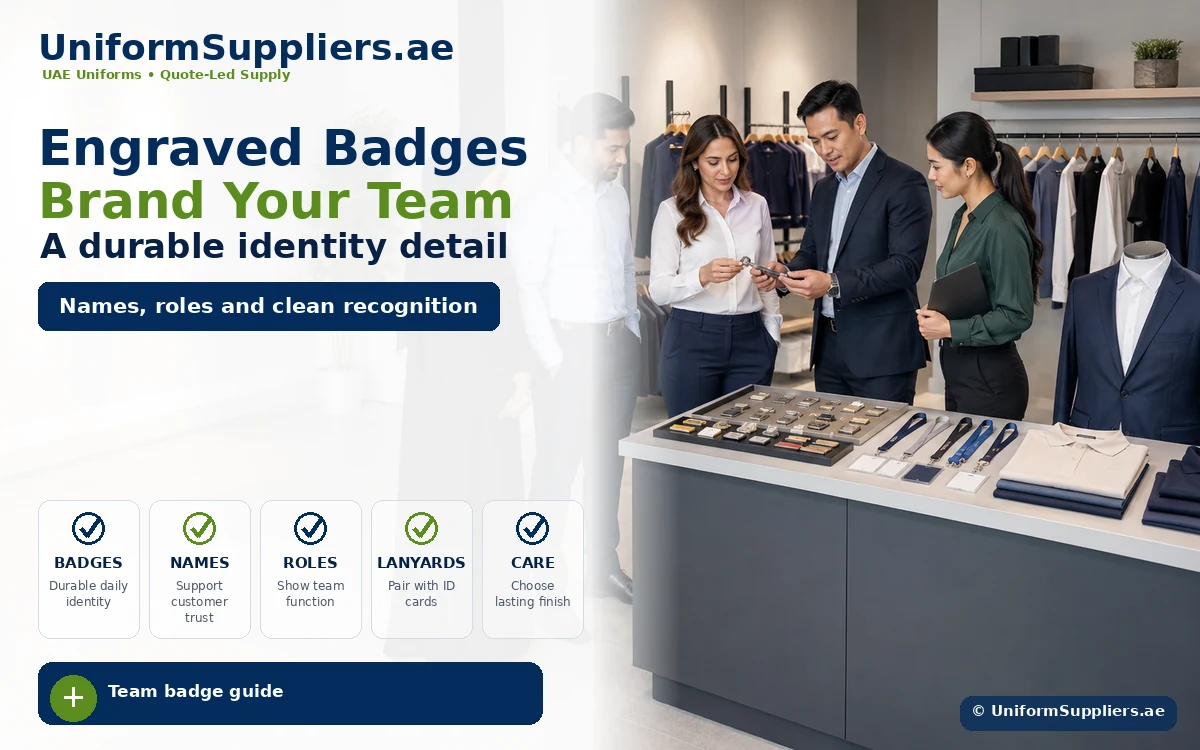
Badges are one of the smallest items in a uniform programme, yet they carry a disproportionate amount of daily wear. A name badge or security ID is handled, clipped, unclipped and reclipped dozens of times a shift, exposed to sweat, sun and the general friction of a working day. How that badge is branded — printed, adhesive, or engraved — determines whether it still reads clearly after months of that treatment.
This guide looks specifically at engraved badges: how engraving compares to printed or adhesive branding for durability, the material choices available, where the approved one-year no-fading warranty applies, and the design considerations that make an engraved badge legible and effective.
For a broader comparison of engraved, printed and reusable badges alongside ID cards and lanyards, see the wider accessories guide: name badges, ID cards and lanyards — small details, big impact. This article goes deeper on engraved badges specifically.
What this guide covers
- Why badge durability matters more than it looks
- Engraving compared with printed and adhesive badges
- Material options: metal and durable plastic
- The one-year no-fading warranty on eligible engraved badges
- Where durability matters most
- Design and branding considerations for engraving
- Materials and durability at a glance
- Frequently asked questions
Why badge durability matters more than it looks
A badge is handled constantly. Security officers, healthcare staff, facilities teams and front-of-house employees clip and unclip badges throughout a shift, often several times an hour, and in UAE conditions that handling happens alongside heat, humidity and, for outdoor roles, direct sun exposure. Printed text and adhesive labels are the first casualties of that combination — surface print wears through with contact, and adhesive layers can lift at the edges over time.
A badge that has faded, scratched or peeled looks unprofessional at exactly the moment it matters most: when a guest, patient or visitor is checking who they are dealing with. For roles where identity verification is functional rather than decorative — security, healthcare, regulated facilities — a badge that is hard to read is a genuine operational problem, not just a cosmetic one.
Engraving addresses this directly by cutting or marking the name and details into the material itself, rather than sitting a layer of ink or film on top of it. There is nothing on the surface to wear off, because the mark is the surface.
Engraving compared with printed and adhesive badges
Printed badges are produced by printing text and logos onto a badge blank, sometimes with a protective laminate layer on top. They are quick to produce and cost-effective for short-term or high-turnover needs, such as event staff or temporary contractors. Their weakness is exactly what makes them fast to produce: the print sits on the surface, and surface layers degrade with handling, sun exposure and repeated cleaning.
Adhesive or self-stick badges — often used for visitor passes or short-term ID — are designed to be disposable. They are not intended to survive daily reuse over months, and are not a fair comparison for permanent staff identification.
Engraved badges are made by mechanically or laser-cutting the design into the badge material, then typically filling the engraved recess with a contrasting colour so the text stands out clearly. Because the information is physically part of the material rather than a coating on it, engraved badges resist the abrasion, fading and edge-lifting that eventually affects printed and adhesive badges. This makes engraving the more durable option for staff who wear a badge every working day over an extended period.
Material options: metal and durable plastic
Engraved badges are available in two broad material families, each suited to slightly different needs.
Metal badges — typically an anodised aluminium or similar metal base — give the most premium appearance and the highest resistance to scratching and general wear. They suit roles where the badge is a visible part of a formal uniform, such as front-of-house management, security supervisors, or hotel and healthcare staff where presentation is part of the brand experience.
Durable plastic badges — a dense, engravable plastic laminate — offer a lighter-weight, more cost-conscious alternative that still engraves cleanly and resists fading far better than a printed surface. They are a practical choice for larger teams where every role needs a badge, and where the premium feel of metal is not the priority.
Both materials can be engraved with a name, job title, employee number, or a simplified logo mark, and both accept a standard clip, pin or badge-reel fitting. Final specification — including exact material grade, size and fitting — will be confirmed during quotation based on the role and quantity involved.
The one-year no-fading warranty on eligible engraved badges
Eligible engraved badges from Uniform Suppliers UAE carry a one-year no-fading warranty. Because the design is engraved into the material rather than printed onto it, the text and logo mark do not rely on a surface coating that can wear away — which is the basis for offering this warranty on engraved badges specifically, and not on printed alternatives.
For any organisation weighing up the slightly higher unit cost of engraving against a printed badge, the warranty is a concrete way to compare the two: a printed badge has no equivalent fading guarantee, because printed ink is expected to wear with handling over time. An engraved badge covered by the warranty is a different proposition — durability is built into the product rather than something you hope holds up.
Where durability matters most
Engraving is worth the investment wherever a badge is worn daily, for an extended period, by staff whose identity needs to be checked at a glance. In the UAE, that applies especially to:
- Security services — badges are inspected regularly by supervisors, clients and sometimes regulators, and need to stay legible through long outdoor shifts.
- Healthcare — clinical and support staff badges are handled constantly, cleaned frequently, and relied on by patients and colleagues for identification.
- Facilities management — multi-site teams often wear the same badge for years, making early wear-through a recurring replacement cost.
- Front-of-house hospitality and retail roles — badges are part of the guest-facing presentation and are handled throughout long service shifts.
For lower-turnover or short-term roles — event staff, seasonal hires, visitors — a printed or adhesive badge remains a reasonable, lower-cost choice. The decision is less about role seniority and more about how long the badge needs to keep looking good.
Design and branding considerations for engraving
Engraving works best with a design that has been simplified for the process. Fine gradients, thin multi-colour detail and small serif text can lose clarity once translated into an engraved line, particularly at the small scale of a standard badge. A logo with strong, simple lines and good contrast between fill and background engraves far more legibly than a complex, full-colour mark.
Text legibility at a small size is the other key consideration. Job titles and employee names need to remain readable at arm’s length, which usually means keeping the font clean and the character count realistic for the badge size chosen. A free digital logo mock-up is provided before production, so the exact engraved layout — logo placement, text size and colour fill — can be checked and approved before any badges are produced.
Mustang recommendation: where a company logo includes fine detail that will not translate well to engraving, request a simplified badge-specific version of the mark as part of the mock-up stage, rather than forcing the full logo onto a small engraved surface.
Is engraving right for your team? A quick comparison
The table below sets out how the three common badge types compare on the factors that matter most for daily wear.
| Factor | Metal engraved | Durable plastic engraved | Printed badge |
|---|---|---|---|
| Durability under daily handling | Highest | High | Lower — surface wears with use |
| Resistance to fading in sun/heat | Very high | High | Fades over time |
| Appearance | Premium, formal | Clean, professional | Bright, flat colour |
| Weight | Heavier | Light | Light |
| Best suited to | Management, security, healthcare | Larger teams, all-role rollouts | Short-term, event or visitor use |
| One-year no-fading warranty | Yes, on eligible badges | Yes, on eligible badges | Not applicable |
As a general checklist: choose engraving where a badge is worn daily for a year or more, where legibility under handling matters operationally (security, healthcare, facilities), or where a consistently sharp appearance is part of the brand standard. Choose printed badges where turnover is high, the role is temporary, or the badge is only needed for a short campaign or event.
Frequently asked questions
What is the real difference between an engraved and a printed badge?
A printed badge has text and logo detail sitting on the surface as ink, sometimes under a laminate layer. An engraved badge has the design physically cut or marked into the material and filled with colour, so there is no surface coating to wear away. This makes engraved badges significantly more durable under daily handling and sun exposure.
Does the one-year no-fading warranty apply to all engraved badges?
It applies to eligible engraved badges from Uniform Suppliers UAE. Eligibility and exact terms are confirmed at the time of quotation, based on the specific badge type and material chosen.
Which material should we choose — metal or durable plastic?
Metal suits roles where a premium, formal appearance matters, such as management or senior security staff. Durable plastic is a lighter, more cost-conscious option that still engraves cleanly and suits larger teams where every employee needs a badge.
Can our existing logo be engraved as it is?
Complex, multi-colour or finely detailed logos often need simplifying to engrave clearly at badge size. A free digital logo mock-up is provided so the engraved version can be reviewed and approved before production begins.
Are engraved badges worth it for a small team?
It depends on how long staff will wear the badge. For a small team wearing the same badge daily over a year or more, the durability and warranty coverage of engraving typically outweigh the higher unit cost compared with a printed badge that will need replacing sooner.
Can engraved badges be reordered later for new starters?
Yes. Specification details are kept on file, so new employees can be issued a matching engraved badge without re-specifying the design, material or layout from scratch.
Ready to brand your team with engraved badges?
Uniform Suppliers UAE, part of Mustang Advertising Trading LLC (Dubai, since October 2007), supplies engraved badges in metal and durable plastic, with eligible badges covered by a one-year no-fading warranty. Explore related branding options via embroidery services, or see the corporate uniforms UAE pillar for wider workforce identity and uniform sourcing. To specify badges for your team, request a quote.