Special offers: free digital logo mock-up and free samples against a confirmed LPO. View offers


The Complete Guide to Security Uniforms in the UAE

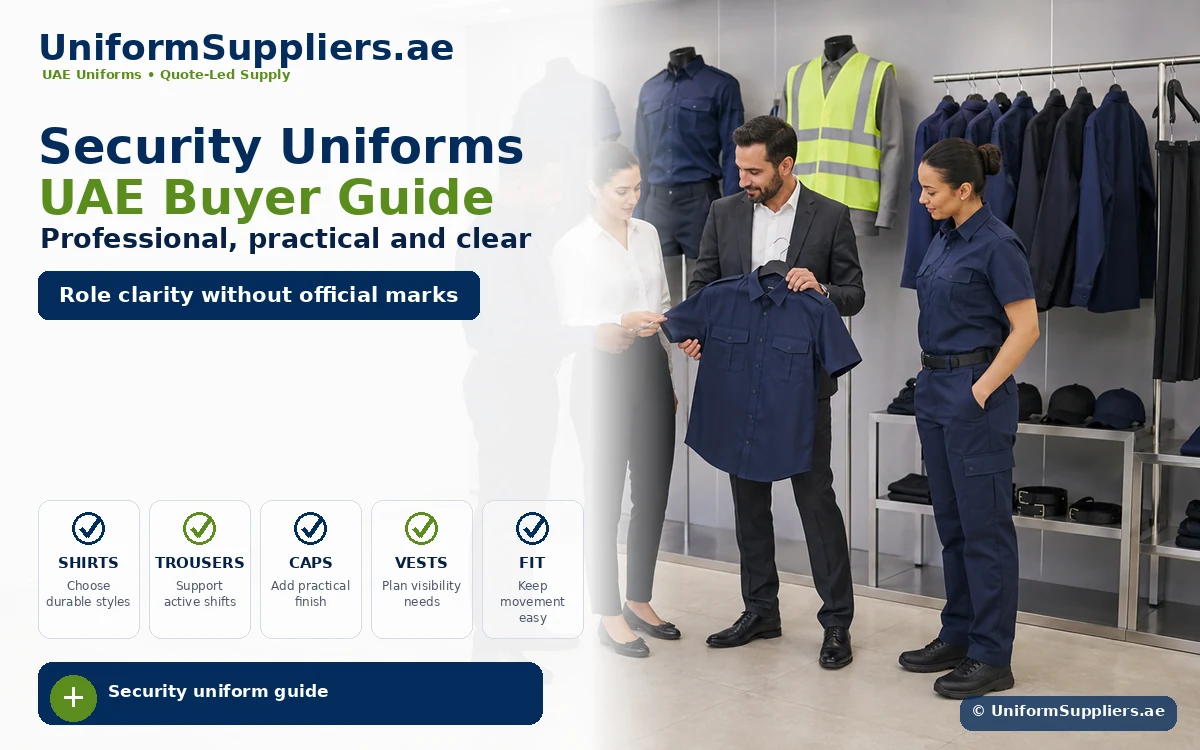
A security officer’s uniform has a job few other roles ask of a garment: it has to project authority and calm confidence on sight, while standing up to long shifts that are often outdoors, in UAE heat, on foot for hours at a time. Get it wrong and the effect is the opposite of intended — an officer who looks uncomfortable or scruffy undermines the presence the uniform is meant to project.
This guide covers what genuinely matters when specifying security uniforms in the UAE: the core kit, fabric and cut for comfort through long shifts, identification and rank markers, integration with badges and equipment, and how hi-visibility considerations apply to some security roles.
What this guide covers
- The core security kit
- Projecting authority without sacrificing comfort
- Fabric and cut for long outdoor shifts
- Rank, name and company identification
- Integration with badges, radios and equipment belts
- When hi-vis applies to security roles
- Footwear for standing and patrol roles
- Reordering and consistency across a growing team
- Kit by role: static, patrol and supervisor
- Frequently asked questions
The core security kit
Most UAE security uniforms are built around a structured shirt or jacket, matching trousers, and a cap or beret, with a blazer or heavier jacket added for supervisory roles or cooler-season outdoor duty. Colour is usually dark — navy, black or charcoal — chosen for a professional, authoritative appearance that also hides everyday soiling better than lighter tones across a long shift.
Accessories complete the kit: a company-branded epaulette or shoulder tab, a name badge, and often a utility or duty belt for radio, torch and other equipment carried through a shift. Each of these elements is usually specified once as part of the overall programme rather than left to individual preference.
Projecting authority without sacrificing comfort
A uniform that looks sharp in a fitting room but becomes crumpled and uncomfortable three hours into a shift undermines the very authority it was designed to project. Structured tailoring — a properly interfaced collar, a defined shoulder line, crisp creases that hold — gives the visual authority security uniforms are known for, but the fabric underneath that structure needs to breathe and move, particularly for a role spent largely standing or walking.
A performance-blend fabric with a small percentage of stretch, built with a structured outer appearance, increasingly replaces the fully rigid traditional security uniform fabric for exactly this reason — it holds a sharp look at the start of a shift and stays wearable at the end of it.
Fabric and cut for long outdoor shifts
Security roles in the UAE frequently involve standing at an entrance, patrolling a perimeter, or working a static post outdoors for extended periods, often across the hottest parts of the day. Breathable fabric with moisture-wicking properties reduces heat stress compared with a heavier, fully-lined traditional uniform fabric, without sacrificing the structured appearance the role calls for.
Cut matters too: a slightly generous fit through the shoulders and underarms allows a full range of movement for reaching, restraining equipment on a belt, or responding quickly if needed, while still reading as sharp and professional when standing still. Ventilated back panels, where the design allows for them without compromising appearance, help manage heat on outdoor static posts.
Rank, name and company identification
Clear identification is functional, not decorative, for a security role — visitors, staff and clients need to be able to identify an officer’s name, role and the company they represent at a glance. Embroidered name and rank details on the chest or epaulette, alongside a company logo, are the standard approach, kept legible and consistent across the whole team rather than varying by individual preference.
Where a team includes multiple ranks or roles — static guard, supervisor, control-room staff — a simple, consistent visual system (an extra stripe, a different epaulette colour, a supervisor blazer) helps colleagues and the public identify seniority quickly without needing an elaborate ranking structure.
Integration with badges, radios and equipment belts
Security uniforms need to work alongside the equipment an officer actually carries — a radio, a torch, sometimes a duty belt with additional items. Pocket placement and belt loops should be planned around this equipment from the specification stage, rather than treating the uniform and the equipment as unrelated purchasing decisions.
Durable, legible identification is particularly important for a role where a badge is checked frequently by supervisors, clients or the public. For badge material and durability options, see our guides on name badges, ID cards and lanyards and, for a badge built to last the length of a long-serving officer’s tenure, engraved badges, which are not repeated in detail here.
A duty belt, where used, should be specified alongside the trouser waistband and belt loops rather than assumed to fit any standard trouser. Loop placement and reinforcement around the waistband are small details that make a real difference once a belt is loaded with a radio, torch and other items for a full shift.
When hi-vis applies to security roles
Not every security role needs hi-visibility clothing, but some genuinely do — officers directing traffic at a site entrance, working near vehicle movement in a logistics yard, or patrolling in low light. Where this applies, the hi-vis element should be integrated into the uniform design (a hi-vis vest layer, or reflective trim built into the main garment) rather than treated as an afterthought. For the technical detail on hi-vis classification and reflective tape, see our dedicated guide to hi-vis and reflective workwear, which this article does not repeat.
Footwear for standing and patrol roles
Footwear is worth planning alongside the main uniform even though it is often sourced separately. Static roles spent mostly standing benefit from supportive, cushioned soles suited to hours on a hard surface, while patrol roles covering more ground across a site need a lighter, more flexible shoe without sacrificing durability. Where a role involves any exposure to vehicle yards, construction-adjacent areas or similar hazards, safety footwear may be appropriate — see our guide on choosing safety shoes and boots for UAE worksites for that scenario specifically.
For most front-of-building or facility security roles without a specific site hazard, a smart, closed, slip-resistant shoe in black is the standard choice, chosen to match the professional appearance of the rest of the uniform rather than for technical safety performance.
Reordering and consistency across a growing team
Security teams often grow or rotate staff more frequently than office-based roles, particularly where a contract covers multiple sites or shifts. Keeping the approved uniform specification — fabric, colour, rank system, badge design — as a stored repeat-order record means a new officer can be equipped quickly against the existing standard, rather than each new hire triggering a fresh specification conversation.
This matters operationally as well as visually: a security team where uniforms drift slightly between hires over time looks less coordinated and, over time, less credible to the clients and staff it is meant to reassure. A single reference specification, reordered consistently, avoids that slow drift.
Kit by role: static, patrol and supervisor
| Role | Typical kit emphasis |
|---|---|
| Static guard | Structured shirt/jacket, breathable fabric for long standing periods, high visual authority |
| Patrol/mobile guard | More freedom of movement, moisture-wicking fabric, hi-vis where near traffic or working after dark |
| Supervisor | Blazer or distinguishing layer, clear rank marking, same base fabric as the team for consistency |
Mustang recommendation: confirm equipment carried on shift — radio, torch, duty belt — before finalising pocket and belt-loop placement, and keep rank identification simple and consistent rather than building an elaborate visual hierarchy.
Frequently asked questions
What fabric works best for security uniforms in UAE heat?
A performance-blend fabric with a small percentage of stretch, built to hold a structured appearance while remaining breathable, generally outperforms fully rigid traditional uniform fabric for officers on long outdoor shifts.
Do all security officers need hi-vis clothing?
No — only roles genuinely exposed to vehicle traffic, low-light conditions, or similar visibility hazards. Where it applies, integrate hi-vis into the uniform design rather than adding it as an afterthought.
How should rank be shown on a security uniform?
Keep the system simple and consistent — an extra stripe, a distinct epaulette colour, or a supervisor blazer are common approaches that are easy for colleagues and the public to read at a glance.
What should we tell our supplier about equipment carried on shift?
List everything carried during a typical shift — radio, torch, duty belt items — so pocket placement and belt loops are planned around real equipment rather than added as an afterthought.
Are engraved badges worth it for long-serving security staff?
For officers wearing the same badge daily over an extended period, engraved badges resist the fading and wear that affects printed badges under constant handling and sun exposure. See our dedicated guide for the full comparison.
Can new security officers be equipped quickly once the specification is set?
Yes. Stored sizing and specification records mean a new officer can usually be measured and equipped against the existing programme without re-specifying fabric, colour or branding from scratch.
What footwear suits a security role?
A smart, closed, slip-resistant black shoe suits most standing or front-of-building roles. Where a role involves exposure to a specific site hazard — a vehicle yard or construction-adjacent area — safety footwear may be more appropriate than a standard dress shoe.
How do we keep uniforms consistent as our security team grows?
Keep the approved specification — fabric, colour, rank system and badge design — on file as a stored repeat-order record, so every new hire is equipped against the same standard rather than a slightly different interpretation of it.
To specify uniforms for your security team, request a quote from Uniform Suppliers UAE.