Special offers: free digital logo mock-up and free samples against a confirmed LPO. View offers


Ready-Stock vs Custom Uniforms: Which Is Right for You?

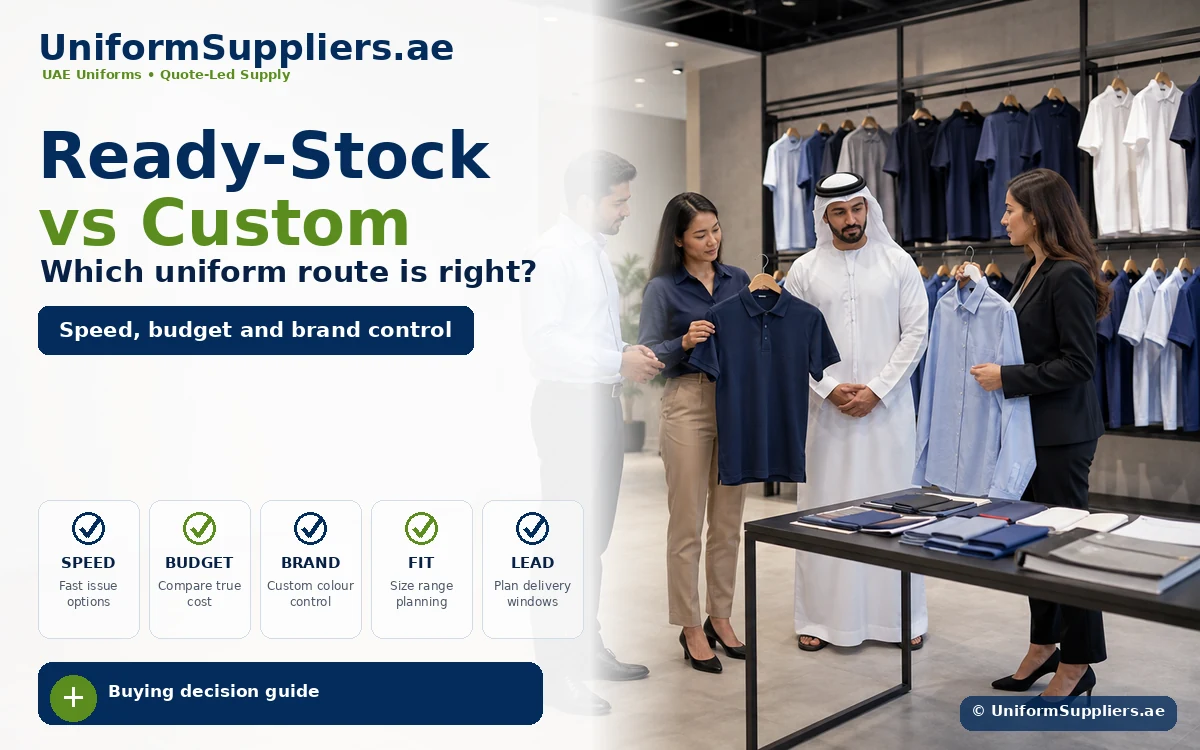
Almost every uniform enquiry in the UAE eventually reduces to one question: do we buy garments that already exist in a warehouse, or do we have a range made to our own specification? The honest answer is that both routes are correct, but for different organisations, and often for different parts of the same organisation.
Ready stock means proven blank garments from established international ranges, decorated with your logo. Custom manufacturing means a garment built to a specification you approve — fabric, colour, cut, trims and labelling.
This guide sets out where each route wins, gives you a scored decision matrix you can run in ten minutes, explains how to combine both in one programme, and shows how to move from ready stock to custom later without wasting the first order. The wider procurement journey is covered in our complete guide to buying company uniforms in the UAE; this article goes deeper on the choice itself.
What this guide covers
- What actually separates the two routes
- Where ready stock genuinely wins
- Where custom manufacturing genuinely wins
- The scored decision matrix
- The hybrid programme: both in one order
- Switching from ready stock to custom later
- Your next step
- Frequently asked questions
What actually separates the two routes
The difference is not quality. Well-made stock garments from established mills outperform a badly specified custom run every time. The difference is control and continuity.
With ready stock you accept someone else’s decisions on fabric weight, colour card, collar shape, placket length and size grading. In return you get garments that already exist, that you can see and handle before committing, and that can be replenished as long as the range remains in production.
With custom uniform manufacturing you make those decisions yourself: fabric composition and GSM, a colour matched to your brand reference, pocket positions, contrast panels, woven neck labels and a size set graded to your workforce. The specification and graded pattern become a retained record, so the tenth reorder matches the first.
Two risks follow. Ready stock carries discontinued-style risk: a mill can retire a colour between your first and second order, and no supplier can prevent that. Custom carries specification risk: anything you fail to define becomes a decision someone else makes for you.
Where ready stock genuinely wins
Ready stock is the right answer more often than buyers expect, particularly in the UAE where mobilisation dates rarely move.
- Urgency. A restaurant soft launch, a mall activation, a new security contract or an unexpected headcount jump does not wait for a production cycle. Stock garments can be decorated and issued while a custom range is still being made.
- Small or uncertain headcount. If you are not yet sure whether the team will be twelve people or forty, committing to a full custom run is premature.
- Short programme life. Event crew, seasonal promotions, exhibition teams and pilot sites do not need a garment designed to survive three years of laundering.
- Wide, unpredictable size spread. UAE teams are multinational by default, and one department can run from XS to 5XL. Established ranges carry that spread as standard.
- You need to touch it first. Stock garments can be worn and washed before you commit — you can see how the garment performs before ordering in volume.
- Simple branding. If a chest logo carries the whole identity, the base garment is a carrier, not the message.
Brands available through Uniform Suppliers UAE include Gildan, Fruit of the Loom, Bella + Canvas, B&C, Russell, AWDis, Next Level, SOL’S and Flexfit/Yupoong, alongside the group brand Nenoush. Full detail on the stock route is on our ready-stock uniforms page.
Where custom manufacturing genuinely wins
Custom becomes the better economic decision as soon as precision, longevity or scale enter the picture.
- Exact brand colour. This is the single most common reason UAE buyers move to custom. Stock colour cards are fixed; a hotel teal or a corporate maroon that sits between two catalogue shades cannot be conjured out of a warehouse. Custom dyeing to an approved reference solves it.
- Roles that need real design. Front office, concierge, spa therapists and chauffeurs are usually where a stock polo stops being credible.
- Long programme life. When the same garment must be reordered for years, a retained specification is worth more than any first-order saving.
- Fabric performance you actually need. A specific GSM, poly-cotton ratio, soil release or stretch panel chosen for Gulf laundering cycles. Our fabric GSM guide explains how to specify it.
- Multi-site or multi-country teams. One approved specification keeps Dubai, Abu Dhabi, Riyadh and Doha visually identical.
- Fit across a diverse workforce. A size set graded from real measurements beats a generic grade.
The full process, from tech pack to pre-production sample, is set out in our custom uniform manufacturing guide.
The scored decision matrix
Run this against one uniform group at a time — not the whole company at once. For each factor, decide which description fits you better and add that row’s weight to that column. Ignore neither column entirely; pick one side per row.
| Factor | Weight | Points to ready stock if… | Points to custom if… |
|---|---|---|---|
| Headcount in this group | 3 | Small team, or figure still moving | Large team, settled figure |
| Number of distinct roles | 2 | One or two roles, similar garments | Several roles needing visible differentiation |
| Expected programme life | 3 | Under a year, or a pilot | Multi-year, with planned replenishment |
| Brand-colour precision needed | 3 | A close catalogue shade is acceptable | Colour must match an exact brand reference |
| Size-range spread | 2 | Very wide and unpredictable spread | Spread known, or non-standard fits needed |
| Urgency of first issue | 3 | Opening or mobilisation date is imminent | Planning window allows a production cycle |
| Budget shape | 2 | Per-piece spend, no set-up appetite | Willing to invest once for lower ongoing cost |
| Reorder frequency | 2 | Rare, ad-hoc top-ups | Regular joiners, quarterly or annual cycles |
| Multi-site consistency | 2 | One site only | Several sites, emirates or GCC countries |
| Existing size file | 1 | No measurement data held | Measured size records already exist |
Scoring rule. Total each column; the weights add up to 23. If one column leads by six points or more, take that route for this group. If the gap is five points or fewer, you are a hybrid case — read the next section, because forcing a single route will cost you either money or credibility.
Mustang recommendation: score your customer-facing roles and your back-of-house roles separately. In most UAE hospitality, retail and facilities businesses the two groups land on different sides of the line, and that split is the correct outcome rather than an inconsistency to be resolved.
The hybrid programme: both in one order
A hybrid programme is not a compromise. It is how most well-run UAE uniform programmes actually operate, and both halves can sit inside a single quotation, one LPO and one delivery schedule.
The usual split is by role. Customer-facing and brand-critical roles are manufactured to specification; high-turnover, high-wear and support roles run on decorated stock garments. Caps, aprons and outerwear are usually stock unless they carry the brand colour.
The second hybrid pattern is chronological. Ready stock covers the opening while custom production completes, then the stock garments become the permanent second-line or spare set rather than being written off. This is the standard answer to a fixed launch date, and it is a normal part of an employee uniform programme.
To keep a hybrid programme from looking assembled by accident, fix three things across both halves: one branding treatment (the same logo size and position, whether embroidered or printed), one colour family so stock shades sit deliberately against the custom colour, and one issue standard so every employee receives the same number of sets, packed individually by name.
Switching from ready stock to custom later
Buyers often delay custom because they assume the first order becomes waste. Planned properly, it does not.
- Buy the stock order with the transition in mind. Choose a base colour and silhouette you would be happy to keep, so the two generations can co-exist on the floor.
- Capture sizes from day one. Record what each employee actually wore, not what they asked for. That file becomes the grading input for the custom range — our measuring and sizing guide covers how to build it.
- Keep a worn garment as evidence. A stock polo after months of Gulf laundering tells a manufacturer more about required fabric weight and colourfastness than any brief.
- Write the specification from observed failures. Collar roll, seam wear, shoulder fading, pockets too shallow for a phone — each becomes a line in the tech pack.
- Approve a pre-production sample before the bulk run. Free samples are available against a confirmed LPO, and free onsite individual measurements are available in the UAE for qualifying company uniform orders.
- Retire in tiers. Issue custom garments to customer-facing staff first and redeploy the stock set to spares, training or back-of-house.
Specification records are retained for repeat orders, so once the custom range exists, later replenishment matches without re-deciding anything. That is exactly the continuity ready stock cannot promise.
Your next step
Score one uniform group on the matrix above, then send the result with your headcount, roles and target issue date. We quote ready stock, custom manufacturing or a hybrid across both, and coordinate delivery across the UAE and wider GCC. A free digital logo mock-up is included so you can see the branding before committing.
Request a Quote — or explore the wider range on our uniform manufacturer in UAE page. Final specification will be confirmed during quotation.
Frequently asked questions
Is custom always more expensive than ready stock?
Not over a full programme. Custom usually carries a higher entry cost because pattern development, sampling and a dedicated production run sit at the front. Ready stock spreads cost evenly per piece. Once you factor in reorders, exchange rates on fit issues and the cost of a mid-programme style change, a long-running custom range frequently settles lower. Compare total programme cost, not first-invoice cost.
Can we brand ready-stock garments as heavily as custom ones?
Yes. Embroidery, screen printing, heat transfer and sublimation all apply to stock garments, and multi-position branding is routine. What stock cannot give you is brand colour in the fabric itself, contrast panels sewn into the construction, or a woven internal label. If your identity lives in the garment rather than on it, that is the point at which custom becomes necessary.
What happens if our ready-stock style is discontinued mid-programme?
Hold a buffer of the core sizes, record the exact style code and colour name in your uniform register, and identify a nominated alternative before you need it. Ask your supplier to confirm whether a style is a long-carried core line or a seasonal one. If continuity is critical to your brand, that argument points to custom.
Can ready stock and custom garments be issued in the same delivery?
Yes, and it is common. Both halves can be quoted together, decorated to the same branding standard and packed employee by employee so each person receives one complete named set. Urgent ready-stock supply while custom production completes is a standard arrangement, particularly for hotel pre-openings, new retail sites and contract mobilisations.
Which route suits a company opening several UAE sites in one year?
Usually a hybrid. Custom-manufacture the roles that define the brand so every site looks identical, and use ready stock for support roles and for covering openings that land ahead of the production schedule. One approved specification held on file keeps later sites consistent with the first, which is the main risk in a multi-site rollout.