Special offers: free digital logo mock-up and free samples against a confirmed LPO. View offers


Uniform Recycling and End-of-Life: What UAE Businesses Can Do With Old Workwear

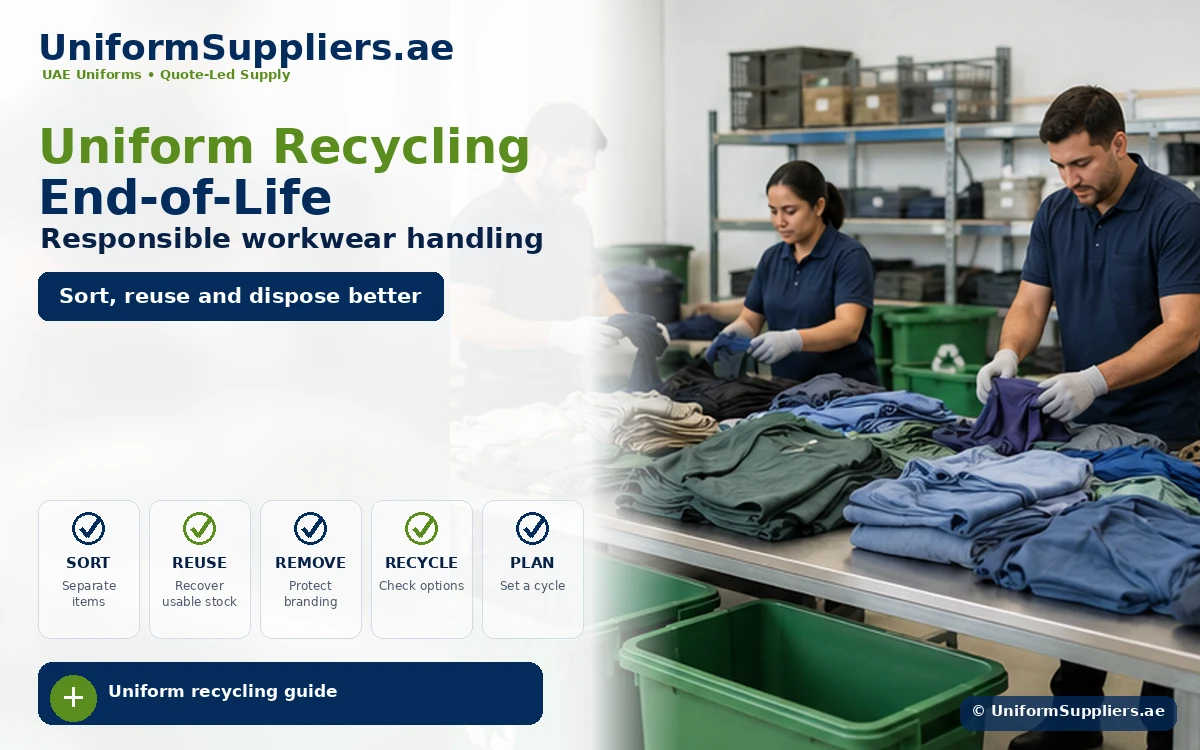
Every uniform programme eventually produces worn-out garments — shirts past their fifth wash-and-wear cycle, coveralls with irreparable tears, branded polos retired after a rebrand. Most UAE businesses default to sending these straight to general waste, largely because no one has set out a better option. This guide looks at what end-of-life uniform handling can realistically look like for a UAE business, and where the genuine options and limits currently sit. For the sourcing side of sustainability — fabric choice and ethical supply chain questions — see our related guide on sustainable and ethical uniforms, which this article deliberately does not repeat.
Table of Contents
- Why End-of-Life Planning Is Worth Doing
- Understanding a Uniform’s Realistic Lifecycle
- Options for Retired Uniforms
- The Branded-Garment Problem
- Removing Identifiers Before Disposal
- What We Don’t Claim
- Comparison: End-of-Life Options
- Checklist: Planning an End-of-Life Process
- FAQs
Why End-of-Life Planning Is Worth Doing
Uniform replacement is usually planned carefully — sizing, fabric, branding, delivery timing all get attention. What happens to the garments being replaced is usually not planned at all. For a business ordering uniforms for a team of any meaningful size, that adds up to a steady stream of retired garments every replenishment cycle, most of which currently has no defined destination beyond general waste.
Beyond the environmental angle, there’s a practical governance reason to think about this: retired uniforms often still carry visible branding, and in some cases staff ID references or access-adjacent details. A defined end-of-life process closes that loop deliberately, rather than leaving branded garments to end up in second-hand markets or informal donation piles with no oversight.
Understanding a Uniform’s Realistic Lifecycle
Garment lifespan varies enormously by role and fabric. A corporate shirt worn in an air-conditioned office and laundered gently might remain presentable for two to three years of an annual replacement cycle. A hi-vis coverall on a construction site, exposed to abrasion, sun and frequent industrial laundering, may show serious wear within months. Planning for end-of-life realistically starts with recognising that different garment categories will retire at different rates, and a one-size approach to disposal won’t fit all of them equally well.
Our guide to uniform care and laundering covers how proper care extends a garment’s working life before it reaches end-of-life at all — the single most effective lever most businesses have, and worth reviewing before investing in a disposal process for garments that could simply be lasting longer.
Options for Retired Uniforms
Once a garment genuinely reaches the end of its useful working life, a UAE business generally has a small number of realistic paths available, and the right one depends on the garment’s condition and branding.
Textile recycling. A number of UAE municipalities and private operators now run textile collection points and bins, accepting clothing for recycling into industrial rags, insulation material or fibre reclamation. Availability and exact process vary by emirate, so it’s worth checking current provision with your local municipality rather than assuming a uniform national scheme exists.
Repurposing internally. Garments in reasonable condition but retired due to a rebrand or role change can sometimes be repurposed for lower-visibility internal use — cleaning cloths, workshop rags, or non-public back-of-house wear — provided any external branding is removed or no longer visible.
Donation. Genuinely wearable, unbranded or de-branded garments can in some cases be donated through established charitable channels. Branded garments generally should not be donated as-is, for the reasons set out below.
Disposal. For garments too worn for any of the above, standard waste disposal remains the fallback. Separating textiles from general waste where a collection point is available is still a meaningful improvement over mixed disposal.
The Branded-Garment Problem
Branded uniforms present a specific challenge that unbranded clothing donation doesn’t: a retired shirt or jacket carrying your company’s name and logo can end up worn by someone with no connection to your business, creating a confusing or even misleading impression to the public. This is a genuine reputational consideration, not just a tidiness one, and it’s the main reason we recommend against donating branded garments without first removing or obscuring the branding.
For businesses ordering in volume, it’s worth raising the branded-garment question with your supplier at the design stage — some branding methods (certain print applications, for example) can be more easily removed or obscured later than others, such as deeply embroidered logos. This isn’t a reason to avoid embroidery, which remains the more durable option for a garment’s working life, but it’s a trade-off worth being aware of at end-of-life.
Removing Identifiers Before Disposal
Beyond company branding, some uniform items carry individual identifiers — a name embroidered directly onto a garment, or an attached ID card or lanyard that wasn’t returned separately. These should be removed or destroyed before a garment leaves your custody, following the same basic principle your business likely already applies to physical ID cards and access badges. A simple step in your offboarding or replacement process — checking that returned or retired garments have identifiers removed before they’re sent for recycling, repurposing or disposal — closes this gap without adding significant overhead.
What We Don’t Claim
Uniform Suppliers UAE does not operate a take-back or garment recycling scheme of our own, and we do not claim any specific environmental certification, carbon offsetting arrangement, or a certified circular supply chain. The guidance in this article reflects general, publicly available options for UAE businesses to consider and is not an offer of a Mustang-run collection or recycling service. Where a business wants to explore a formal collection arrangement, we’re happy to discuss what’s practical to arrange as part of a broader uniform programme — this would be scoped and confirmed individually, not offered as a standard service today.
Common Triggers for Retirement
Uniforms typically get retired for one of a small number of predictable reasons, and it’s worth planning for each slightly differently. Simple wear and tear from regular use is the most common trigger, and is best addressed by the care and laundering practices covered in our related guide referenced above — extending a garment’s working life reduces how often end-of-life decisions come up at all.
A rebrand or logo update is a different kind of trigger, and often produces a larger single batch of retired garments than gradual wear-and-tear replacement does, since an entire team’s uniforms may be retired at once even though the garments themselves are still in good physical condition. This scenario is where the branded-garment question below becomes most relevant, since a business may be sitting on a genuinely large quantity of still-wearable, but now off-brand, clothing.
Staff departures are a third common trigger, particularly for roles issued individually fitted or named garments. Where a uniform is returned as part of standard offboarding — which we’d recommend building into your process if it isn’t already — that returned garment then needs the same end-of-life consideration as any other retired item, including identifier removal.
Planning Ahead for the Next Replenishment Cycle
Businesses that already run a regular uniform replenishment cycle — see our guide to annual uniform replenishment — are well placed to fold an end-of-life step into that same cycle, rather than treating disposal as a separate, ad hoc task each time. Reviewing what happens to outgoing garments at the same point you’re planning incoming ones keeps the whole process visible and consistent, rather than leaving retired uniforms to accumulate in a storeroom with no clear next step.
For larger organisations managing uniforms across multiple departments or sites, assigning a single point of ownership for the end-of-life step — often the same person or team who owns uniform kitting and replenishment more broadly — avoids the process falling through the cracks between departments, each assuming someone else is handling it.
Comparison: End-of-Life Options
| Option | Best for | Key consideration |
|---|---|---|
| Textile recycling | Worn but intact garments, any branding | Availability varies by emirate |
| Internal repurposing | Reasonable-condition, retired-by-rebrand garments | Remove or obscure branding first |
| Donation | Unbranded or de-branded, wearable garments | Avoid donating branded items as-is |
| Standard disposal | Garments beyond any other reasonable use | Separate textiles where possible |
Checklist: Planning an End-of-Life Process
- Extend garment life first through proper care and laundering before considering disposal
- Check current textile recycling provision with your local municipality
- Remove or obscure company branding before donating any garment
- Remove individual identifiers (embroidered names, attached IDs) before a garment leaves your custody
- Consider internal repurposing for lower-visibility use before disposal
- Document a simple end-of-life step in your standard uniform replacement process
FAQs
Does Uniform Suppliers UAE offer a garment take-back scheme?
Not as a standard service today. We can discuss a scoped collection arrangement as part of a broader programme, but this would be confirmed individually rather than offered as an existing scheme.
Is textile recycling widely available across the UAE?
Provision varies by emirate and municipality. We recommend checking current collection points with your local municipality rather than assuming a single national scheme applies everywhere.
Can we donate old branded uniforms to charity?
We recommend removing or obscuring company branding first. A branded garment worn by someone with no connection to your business can create a misleading impression, so de-branding before donation is the safer approach.
How do we handle staff names embroidered on retired uniforms?
Treat embroidered names and attached ID items the same way you would a physical access badge — remove or destroy them before the garment leaves your custody, as part of your standard offboarding or replacement process.
Want to talk through a practical end-of-life or replenishment plan alongside your next uniform order? Request a quote and we’ll help you think through the full lifecycle, not just the initial rollout.