Special offers: free digital logo mock-up and free samples against a confirmed LPO. View offers


Staff and Teacher Uniforms for UAE Schools and Nurseries

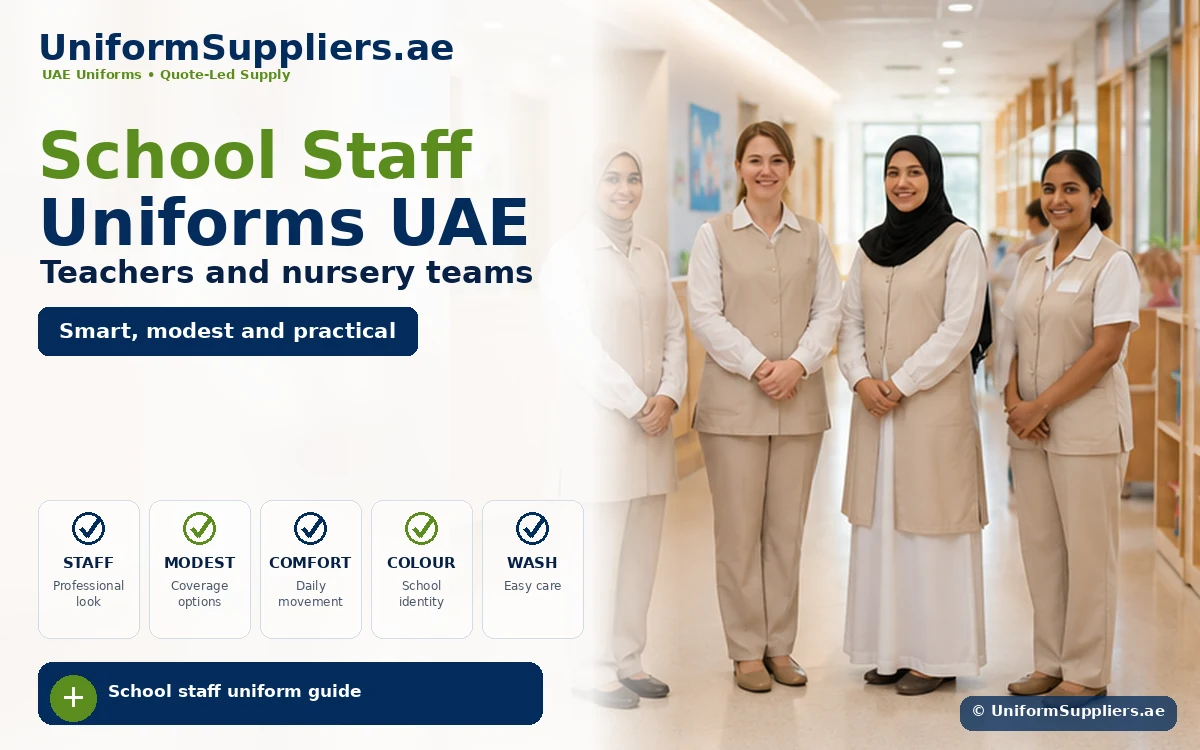
Most school uniform planning in the UAE understandably centres on students — daywear, PE kits, sizing across age groups. Teacher and support-staff uniforms are usually addressed as an afterthought, if at all, even though staff dress is what parents and inspectors see at the gate every morning. This guide focuses specifically on staff and teacher uniforms for UAE schools and nurseries: a distinct brief from student uniforms, with its own comfort, professionalism and practicality requirements. For student daywear and PE kit specification, see our complete guide to school uniforms in the UAE and our guide to school sportswear and PE kits, which this article deliberately does not repeat.
Table of Contents
- Why Staff Uniforms Are a Separate Brief
- Teaching Staff: Comfort for a Full Working Day
- Nursery and Early-Years Staff
- Support, Admin and Facilities Staff
- Branding and Role Differentiation
- Sizing Across a Diverse Staff Body
- Comparison: Staff Categories and Uniform Priorities
- Checklist: Planning a School Staff Uniform Programme
- FAQs
Why Staff Uniforms Are a Separate Brief
Student uniforms are specified around growth cycles, parent purchasing and consistent daywear rules. Staff uniforms are specified around a completely different set of constraints: an adult workforce wearing the same garments for a full working day, often standing, moving between classrooms, outdoor areas and administrative spaces, sometimes across an entire academic year in UAE heat. Comfort, durability and easy laundering matter more here than in a student uniform brief, where garments are typically replaced as children grow.
Staff uniforms also carry a different signalling role. Where a student uniform communicates the school’s identity to the outside world in a general sense, a staff uniform communicates authority, approachability and role — parents and pupils should be able to tell a teacher from a teaching assistant, and a facilities team member from a security guard, at a glance.
Teaching Staff: Comfort for a Full Working Day
Teachers spend long days on their feet, often in classrooms without the same air conditioning intensity as an office, and increasingly move between indoor and outdoor teaching spaces. Breathable, easy-move fabrics matter more here than in a typical office corporate uniform. Polo shirts or soft-collar shirts paired with smart trousers or skirts are a common, practical base layer, often with a school-branded cardigan or blazer for more formal occasions such as assemblies or parent meetings.
Many UAE schools now offer teaching staff a choice between two or three approved garment styles within the same colour and branding palette, rather than a single rigid uniform, to accommodate different comfort preferences and body types while still presenting a consistent, coordinated look across the staff body.
Nursery and Early-Years Staff
Early-years and nursery staff have the most physically demanding uniform brief in a school setting — frequent bending, sitting on the floor, exposure to messy play, food and cleaning products, and close physical contact with young children. Fabric choice should prioritise stretch, machine-washability at higher temperatures, and colourfastness under frequent washing over formal appearance. Soft, rounded trims and the absence of hard buttons or decorative elements near the collar are practical safety considerations worth raising with your supplier at the specification stage.
Many nurseries specify a distinct colour or style for early-years staff versus primary or secondary teaching staff, both for easy identification by parents at drop-off and pick-up and to allow different fabric and fit priorities without breaking overall brand consistency.
Support, Admin and Facilities Staff
Reception and administrative staff typically follow a corporate-style uniform brief closer to an office environment — see our guide on dressing your front-office team for the underlying principles. Facilities, maintenance and cleaning staff have a very different brief, closer to industrial workwear, prioritising durability and ease of movement over formality; our guide to facilities management uniforms covers this in more depth for larger, multi-site school groups.
Security staff at school gates are often supplied separately through a security contractor rather than by the school itself, but where a school does specify its own security uniform, visibility, approachability and a clearly distinct look from both teaching staff and visitors are the key priorities.
Branding and Role Differentiation
A school crest or logo embroidered on staff uniforms reinforces institutional identity, but role differentiation matters just as much for day-to-day operations. Colour-coding by department or seniority — for example, a different polo shirt colour for teaching assistants versus lead teachers — helps parents, pupils and visiting inspectors navigate a large campus quickly. Name embroidery, rather than a separate name badge, is a common and durable choice for teaching staff, since badges can be misplaced or damaged during active classroom work; see our comparison of name badges, ID cards and lanyards for a fuller comparison of identification options.
Sizing Across a Diverse Staff Body
A school staff body is typically far more size- and age-diverse than a corporate office team, spanning a wide range of body types over a long-serving, multi-year workforce. A uniform range specified with a narrow size run will inevitably leave some staff in an ill-fitting garment, which affects both comfort and how confidently staff represent the school. Specifying an inclusive size range from the outset, rather than adding sizes reactively after a rollout, avoids uncomfortable individual exceptions later.
Policy, Enforcement and Onboarding New Staff
A staff uniform policy works best when it is written down and shared during onboarding, rather than communicated informally by department heads and left open to individual interpretation. Set out clearly which garments are mandatory, which are optional add-layers such as cardigans or blazers, and how staff should present when moving between teaching, outdoor duty and formal school events such as open days or inspections. For a step-by-step approach to drafting this kind of document, our guide on writing a uniform policy for your UAE company covers the same principles applied to a corporate setting, most of which translate directly to a school context.
New staff onboarding is a natural trigger point for uniform issue, ideally timed to arrive before a teacher’s first day rather than being handled reactively once they’ve already started in plain clothes. Schools that experience high seasonal staff turnover around the start of the academic year benefit from planning uniform kitting as part of the broader HR onboarding checklist — our guide to uniform kitting for new employees sets out a general framework that applies well to a school’s staff intake cycle, including sizing capture ahead of a confirmed start date so new teachers are correctly kitted from day one rather than issued an approximate size to be corrected later.
Consistent enforcement matters for staff uniforms in the same way it does for student uniforms — a policy that is only loosely followed undermines the professional, consistent image the uniform programme was designed to create. Many schools nominate a single point of contact, often in HR or facilities, responsible for uniform issue, replacement requests and policy questions, so staff have one clear channel rather than an ad hoc process that varies by department.
Comparison: Staff Categories and Uniform Priorities
| Staff category | Primary garment | Top priority |
|---|---|---|
| Teaching staff | Polo/shirt + trousers or skirt, optional cardigan | Comfort across a full teaching day |
| Nursery / early-years | Stretch tunic or polo + trousers | Washability, freedom of movement |
| Admin / reception | Corporate shirt or blouse | Professional first impression |
| Facilities / maintenance | Workwear polo or coverall | Durability |
| Security (school-specified) | Distinct visible uniform | Clear differentiation from visitors |
Checklist: Planning a School Staff Uniform Programme
- Separate the staff brief from the student uniform brief — different fabric and fit priorities apply
- Offer 2–3 approved garment styles within one palette rather than a single rigid option
- Specify higher-durability, machine-washable fabric for nursery and early-years staff
- Colour-code by department or seniority for at-a-glance identification
- Confirm an inclusive size range covering your full staff body before ordering
- Decide between embroidered names and removable badges for teaching staff
FAQs
Should nursery and primary teaching staff wear the same uniform as secondary staff?
Many UAE schools differentiate by colour or garment style across age phases, both for parent/pupil identification and because early-years staff have different comfort and washability needs than secondary teaching staff. Final specification will be confirmed during quotation based on your school’s structure.
Can staff uniforms be introduced gradually rather than all at once?
Yes. Many schools introduce a new staff uniform at the start of an academic year, with a phased rollout across departments if needed. Our team can help plan a rollout that fits your school calendar.
Do teaching assistants need a different uniform from lead teachers?
Some schools colour-code by role for quick identification, while others keep a single consistent teaching-staff uniform across all levels. Both are common approaches — the right choice depends on your school’s size and how important at-a-glance role identification is on your campus.
How do we handle sizing for a very diverse staff body?
We recommend confirming your full staff size range, including plus sizes and petite fits, before finalising your order rather than adding sizes reactively. Our onsite measurement service can help capture accurate sizing across a large staff body.
Who should own the staff uniform policy within a school?
Most schools assign this to HR, facilities, or a designated administrator, giving staff a single point of contact for issue, replacement and policy questions rather than leaving it to individual department heads to interpret informally.
Can a multi-campus school group standardise staff uniforms across locations?
Yes, and many groups do so deliberately to present one consistent brand across campuses, while still allowing minor climate- or role-based variation where a specific campus or department genuinely needs it. This is best planned centrally rather than left to individual campuses to decide independently.
Ready to plan a uniform programme for your school’s teaching and support staff? Request a quote and our team will help you specify a staff range that’s comfortable, durable and clearly differentiated by role.