Special offers: free digital logo mock-up and free samples against a confirmed LPO. View offers

Flame-Resistant Workwear for Oil and Gas Teams

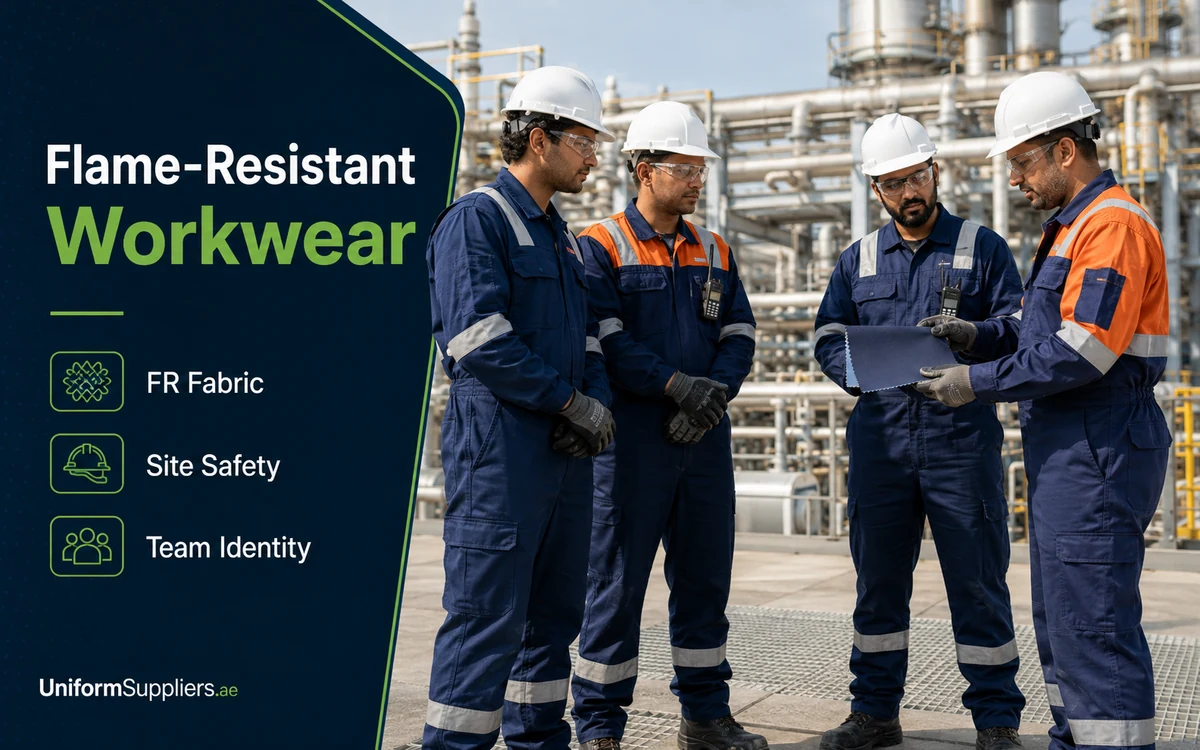
Flame-resistant workwear is one of the few uniform categories where the garment is life-safety equipment rather than a presentation item. On a gas plant in Abu Dhabi or an offshore support vessel in the Gulf, a technician’s coverall is the last barrier between a short flash fire and the skin underneath.
Colour, logo placement and cut still matter, but they sit beneath technical decisions that must be written into the tender, evidenced by the supplier, then protected through correct laundering and honest retirement rules.
This guide is for HSE managers and procurement officers at UAE oil, gas, energy and utilities contractors. It is general guidance only: protective clothing selection must be based on the employer’s own risk assessment and on the manufacturer’s certification for the specific garment supplied.
What this guide covers
- Why FR workwear is not ordinary workwear
- The standards buyers are asked to reference
- FR specification decision table
- What crews wear underneath
- Wearability and site reality in the UAE
- Laundering, contamination and garment life
- Datasheet and certificate request checklist
- Specifying your FR programme
- Frequently asked questions
Why FR workwear is not ordinary workwear
A standard polycotton coverall will ignite and, with many synthetics, melt onto skin. Flame-resistant fabric resists ignition, self-extinguishes once the ignition source is removed, and does not melt or drip. It buys escape time and reduces burn area rather than making the wearer fireproof.
You are buying a garment whose fabric, thread, closures and tape were tested as a system, with a certificate you can produce at audit. A polyester zip or non-FR thread becomes a failure point.
The standards buyers are asked to reference
This is general explanation so you can read a datasheet and write a tender clause. It does not state that any garment meets any standard; only the certificate issued for that model evidences that.
EN ISO 11612 — heat and flame
The general-purpose standard for clothing protecting against brief flame contact and heat. A mandatory limited flame spread requirement is combined with optional lettered codes covering, broadly, convective, radiant and contact heat plus molten aluminium and molten iron splash, each at a level. A garment is described by the letters and levels it achieved, so the standard number alone is not a specification.
EN ISO 11611 — welding and allied processes
Aimed at welding and comparable risks, particularly small spatter and short flame contact. It is generally expressed in classes reflecting the severity of the activity, with design requirements covering body coverage and pocket closure. If hot works are in scope, specify it alongside the heat and flame standard.
Arc flash versus flash fire
Flash fire comes from an ignited hydrocarbon cloud: short, engulfing, high temperature. Arc flash comes from an electrical fault and is assessed using incident energy, commonly expressed in calories per square centimetre. An arc rating is a number tied to a specific fabric and construction, so it must appear on the datasheet as a figure, not a claim that a garment is “arc safe”. A fabric can suit one exposure and be under-specified for the other.
High visibility combined with FR
Hi-vis is not a matter of stitching ordinary tape onto FR fabric. Background material and tape must both be suitable for flame-resistant clothing, and the combined garment is assessed against both standards, including tape performance after washing.
FR specification decision table
Use this as the skeleton of your specification. The last column is what most tenders forget: wording that forces evidence rather than assertion.
| Decision point | Options | What it affects | What to require in writing |
|---|---|---|---|
| Fibre route | Inherent FR fibre; FR-treated cotton | Whether protection is intrinsic or applied; comfort; garment life | Composition, GSM, inherent or treated, retained performance after stated wash cycles |
| Garment style | One-piece coverall; two-piece jacket and trouser | Waist coverage, donning over boots, ventilation | Style code, closure system, storm flap detail, confirmation the tested configuration matches the style supplied |
| Layering | Controlled base layer; non-melting natural fibre; no rule | Burn injury even where the outer layer performs; enforceability | A written underlayer rule in the HSE plan, plus datasheets for base layers supplied |
| Exposure type | Flash fire; electric arc; hot works; combination | Which standard and levels apply per role | Standard number and edition, full code letters and levels, and for arc work the rating with test method |
| Hi-vis | FR only; FR with tape; FR fluorescent fabric | Night works, plant movement, client rules | Evidence against both standards for the same garment, including tape performance after washing |
| Laundering regime | Industrial contract laundry; site laundry; domestic washing | Whether performance survives in practice | Care label content, permitted detergents, prohibited agents, maximum temperature, contaminated-garment process |
| Life and retirement | Fixed cycle count; condition-based inspection; hybrid | Budget predictability; audit defensibility | Service-life guidance, defined retirement triggers, a records format your client auditor accepts |
Where a point is still open at enquiry stage, that is normal. Final specification will be confirmed during quotation.
What crews wear underneath
An FR outer layer can be defeated by what the wearer puts underneath. Polyester t-shirts, nylon-elastane sports tops and synthetic socks can melt from heat transmitted through the outer garment even when that garment does not ignite, turning a survivable event into a severe injury.
Synthetic “cooling” shirts are what workers buy for themselves in summer, and a rule that lives only on an induction slide will not survive August. Supply the base layer within the programme, in enough quantity that nobody substitutes, and inspect at toolbox checks.
Wearability and site reality in the UAE
From May to September, shade temperatures sit in the mid-forties with high humidity, and jetty-side or offshore work adds glare and reflected heat. A garment that is technically excellent but unbearable at 11am creates a second safety problem: unzipped fronts, rolled sleeves and heat stress.
Fabric weight is the first lever buyers reach for, and lighter constructions can suit where the risk assessment supports them, but that trade-off belongs to the employer with competent advice. Design helps: action backs and gusseted underarms improve airflow, two-piece sets let a crew shed the jacket in a rest area, and generous sizing preserves the air gap that aids thermal protection.
Most UAE energy work runs under a client HSE plan setting requirements above the legal baseline, often mandating colours, tape configuration and logo position. Read it before you specify. On multi-contractor sites those colours double as a supervision tool at permit control and muster, so agree the matrix early and record specification per role, not per order — what a structured employee uniform programme holds. Our guide to industrial workwear by hazard covers garment-to-hazard mapping.
Laundering, contamination and garment life
Protective performance is not permanent. It degrades with wear, abrasion, repeated washing and, most commonly, incorrect laundering. Three routes cause most of the damage.
- Fabric softeners and some starches leave residue that can itself be combustible, undermining flame behaviour even though the garment looks perfect.
- Chlorine bleach and oxidising agents can attack flame-resistant treatments and weaken fibres, reducing protection and strength.
- Hydrocarbon contamination is the failure most specific to oil and gas: oil, diesel, condensate and grease soaked into a coverall provide fuel, so contaminated garments must be cleaned properly or withdrawn from service.
An industrial laundry contract with a written process is more defensible, because temperature, chemistry and inspection are controlled and recorded. Where garments are washed at home — common for smaller subcontractor crews — instructions must be unambiguous for crews who read Hindi, Urdu, Malayalam, Bengali, Tagalog or Arabic more comfortably than English. Pictograms and short translated instructions on an issue card beat a dense label.
Build retirement in from day one. Typical triggers are holes, charring, thinning, broken closures, lifted or dulled tape, contamination that will not wash out, and unapproved repairs. A garment that fails inspection should be destroyed, not reissued to a new starter.
Datasheet and certificate request checklist
Demand this before award, not after delivery. Asking at tender stage separates suppliers who can evidence what they sell.
- Standard and edition — the exact reference including the year.
- Full performance codes — every letter and level achieved, and for arc work the rating with test method.
- Test house or notified body — who tested or issued the certificate, so it can be verified.
- Certificate number and validity — reference, issue date and expiry date.
- Garment model covered — style code and colourway; a certificate for another model in the same fabric is not evidence.
- Fabric identification — fabric name, composition, GSM and weave.
- Wash-cycle basis — how many cycles, of what type, performance was retained after, and the procedure used in testing.
- Care label instructions — a copy of the label, with temperature, prohibited agents and drying method.
- Traceability — batch or lot identification linking delivered garments to the tested fabric.
Keep these with your issue register and inspection records. When an auditor asks how you know the coveralls on site are the ones you specified, that file is the answer. The wider duty is covered in our guide to PPE obligations for UAE employers.
Specifying your FR programme
Uniform Suppliers UAE, the uniform division of Mustang Advertising Trading LLC, has supplied UAE businesses since October 2007 from a Jebel Ali showroom with production and warehouse operations in Dubai. PPE and safetywear supply, embroidery, printing and badge production sit alongside industrial uniforms and safety workwear and oil, gas and energy support.
Every protective property is something you specify and the supplier evidences with a certificate and datasheet for the model supplied. Send your client HSE plan, the roles to be kitted and the exposures in your risk assessment, and requirements can be matched and documented. Free digital logo mock-ups and free samples against a confirmed LPO are available. Final specification will be confirmed during quotation.
Request a quote with your specification, or read the companion PPE checklist for UAE construction sites for a per-trade kit list. Footwear is covered in our guide to safety shoes and boots for UAE worksites.
Frequently asked questions
Is inherent FR always better than FR-treated cotton?
Not automatically. Inherent fibres carry flame resistance in the fibre itself, while treated fabrics rely on a chemical finish, and both are used widely in energy work. Judge them on tested performance level, retained performance after the stated wash cycles, comfort in heat and cost across the service life.
Can FR coveralls be washed in a normal laundry?
Only if that laundry follows the manufacturer’s care instructions exactly. Fabric softener, chlorine bleach and excessive temperatures can all reduce protective performance, and hydrocarbon residue adds fuel. Industrial contracts with a documented process are easier to defend at audit. Where garments are washed at home, supply translated instructions and check compliance.
Does an FR coverall protect against electric arc?
Not necessarily. Flash-fire and arc performance are assessed differently, and a garment suited to one exposure may be under-specified for the other. Arc protection is expressed as a numeric rating for a specific fabric and construction. Where crews face both hazards, state both requirements and ask for both to be evidenced for the same model.
What should workers wear under FR garments in summer?
Avoid melting synthetics such as polyester and nylon base layers, because they can melt against skin even when the outer garment performs correctly. Specify an acceptable alternative in the site HSE plan, issue enough that substitution is unnecessary, and inspect for compliance. Supplying the base layer within the programme beats an induction slide.
How often should FR workwear be replaced?
Replacement should follow inspection and the manufacturer’s service-life guidance rather than a calendar date. Withdraw garments showing holes, charring, thinning, abrasion, failed closures, lifted or dull tape, or contamination that will not wash out. Record each withdrawal so the audit trail matches the garments in use.