


Blog
Choosing Safety Shoes and Boots for UAE Worksites

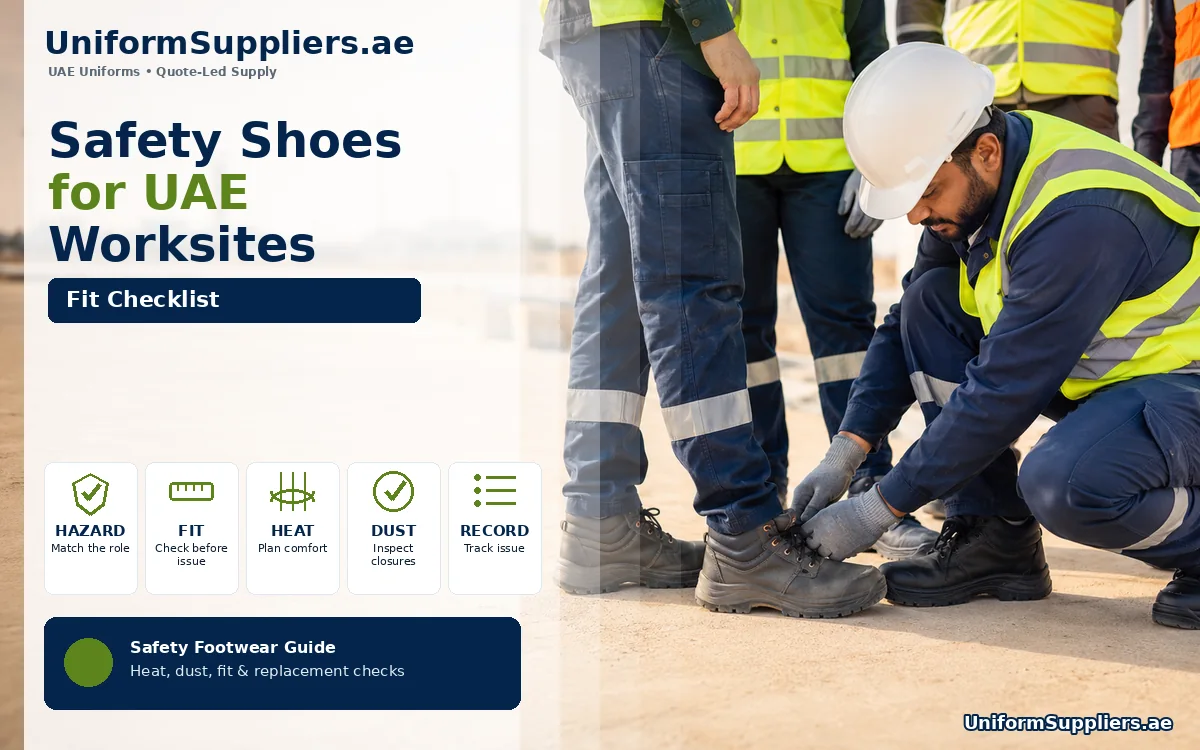
Safety footwear is the only protective item a worker keeps on for the whole shift. On a UAE site it also has to cope with 45-degree afternoons, fine dust that finds every seam, and ground hot enough to be felt through a thin sole.
Most footwear complaints on Gulf projects are not about protection. They are about heat, weight, sweat and fit. A boot worn with the heel crushed down by mid-morning protects nobody.
This guide explains how to read a footwear specification, how to match footwear to the task rather than the site as a whole, and how to run sizing and replacement.
What this guide covers
- Why footwear is the PPE decision sites get wrong
- How to read a safety footwear datasheet
- Heat, sweat, sand and hot ground
- Role-to-footwear selection guide for UAE settings
- Sizing a multi-nationality workforce
- Fit sessions, issue and replacement cycles
- Putting footwear into a tender or LPO
- Frequently asked questions
Why footwear is the PPE decision sites get wrong
Coveralls, gloves and helmets are usually specified with care. Footwear is often bought as one line item: one boot, one price, everybody the same. That is where the trouble starts, because a site rarely has one hazard profile.
The steel fixer, the yard forklift driver, the engineer walking site and the cleaner on wet floors face different risks. Issue one heavy waterproof boot to all of them and supervisors quietly stop wearing it; issue one light boot and the trades needing penetration resistance are exposed. Splitting the order into three or four specifications costs less over a year than replacing one wrong choice twice.
How to read a safety footwear datasheet
Safety footwear sold into the Gulf is commonly described against EN ISO 20345, the European standard for footwear with a protective toecap. Each marking is shorthand for a tested property, so reading them yourself lets you compare datasheets without relying on a sales description.
Two cautions. The standard was revised in 2022 and some markings changed, so check which edition a datasheet uses. And a marking describes the tested product, not your site: your hazard assessment decides what you need.
| Marking | What it means | When you need it | What to check |
|---|---|---|---|
| SB | 200 joule protective toecap only. Nothing more is implied. | Light duty or short visitor use. | That SB is not sold to you as a full site boot. |
| S1 | SB plus closed heel, antistatic properties, heel energy absorption, fuel-oil resistant outsole. | Dry indoor work: workshops, plant rooms, dry stores. | That the area is genuinely dry. S1 has no water resistance. |
| S1P | S1 plus penetration resistance through the sole. | Dry areas with nails, swarf or wire underfoot. | Steel or textile insert, and how much of the sole it covers. |
| S2 | S1 plus resistance to water penetration and absorption through the upper. | Wash-down areas, kitchens, wet external work. | A water-resistant upper is not a waterproof boot. |
| S3 | S2 plus penetration resistance and a cleated outsole. | The usual baseline for open construction and civils. | Cleat depth against the ground actually walked on. |
| P, PL, PS | Penetration resistance. The 2022 revision separates metal from non-metal inserts. | Anywhere sharp objects are trodden on. | Which edition applies. |
| M | Metatarsal protection over the top of the foot. | Heavy handling, drums, kerb and slab laying. | Internal or external guard, and its effect on fit. |
| HRO | Outsole resistant to brief contact with a hot surface. | Hot works, roofing, asphalt and paving. | Short contact only, not standing on hot ground all day. |
| SR / SRC | Slip resistance. Older marks named ceramic and steel test floors; the 2022 revision made a baseline test standard. | Everywhere, critically in kitchens and wash-down zones. | Which test surface and contaminant were used. |
| A / E / HI / CI / WR | Antistatic, heel energy absorption, sole heat or cold insulation, whole-boot water resistance. | Specify individually where the hazard exists; CI for chilled stores. | Antistatic is not electrical insulation, a separate marking. |
Treat this as a reading aid for supplier datasheets. Uniform Suppliers UAE supplies PPE and safetywear, and the protective properties of any item are those declared by the manufacturer. Final specification will be confirmed during quotation.
Heat, sweat, sand and hot ground
From May to September a closed boot becomes its own microclimate. Ten hours of enclosed heat produces a great deal of moisture, which causes blisters, odour and fungal skin problems while destroying linings from the inside. Three things help, and none appear in a marking.
- Two pairs, alternated. A boot needs a full day to dry. Two pairs per worker in the heavy trades extends the life of both and cuts skin complaints.
- A sock policy. Cotton holds sweat against the skin. Moisture-managing socks issued as part of the PPE kit are a cheap comfort win.
- Breathable uppers. Full grain leather is durable but slow to breathe. Perforated leather or textile panels lower internal temperature at some cost in abrasion resistance.
Sand is the second variable. Fine dust enters through lace eyelets and open tongues, then acts like grinding paste against the lining. A bellows tongue and a snug collar matter more here than on a European site, and sand wears cleats down, so tread depth belongs on every inspection.
Hot ground is the third. Asphalt, steel decking and slabs in direct sun conduct heat upwards, and thin soles that suit a conditioned warehouse become punishing on a summer roof. Where heat rises through the floor, ask about sole insulation.
Role-to-footwear selection guide for UAE settings
Use this to split a site order into groups, then confirm each line against your hazard assessment.
| Setting or role | Main hazards | Specification to request | UAE note |
|---|---|---|---|
| Concrete and steel fixing | Nails, tie wire, rebar underfoot, dropped bars | Ankle boot, penetration resistance, cleated outsole, metatarsal option | Wet concrete attacks leather, so expect shorter cycles |
| Plant and vehicle yards | Crush injury, fuel and oil, uneven ground | Ankle support, oil-resistant cleated sole, high-visibility trim | Yard surfaces get extremely hot; check sole heat behaviour |
| Hot works and roofing | Sparks, hot slag, hot surfaces, molten bitumen | Heat-resistant outsole, quick-release closure, no open laces | Ask about sustained heat, not only brief contact |
| Oil and gas process areas | Static discharge, hydrocarbons, slips | Antistatic properties, oil and fuel resistant sole, minimal exposed metal | Client rules often exceed the standard; read the site PPE matrix |
| Warehouse and logistics picking | Long standing, dropped stock, MHE traffic, smooth floors | Lightweight toecap, heel energy absorption, slip-resistant flat sole | Conditioned floors allow lighter footwear than the yard outside |
| Facilities and cleaning | Wet floors, chemicals, indoor and outdoor movement | Water-resistant upper, chemical-resistant sole, wet-surface slip resistance | Temperature swings inside the boot accelerate lining wear |
| Kitchens and wet areas | Grease, hot liquids, constant standing, hygiene rules | Wipe-clean closed upper, high slip resistance, laceless if required | Floors are washed daily, so drainage and drying matter |
| Supervision and visitors | General site hazards, short exposure, vehicle use | Lighter safety shoe or trainer-style boot with full toecap | A comfortable option stops managers walking site in normal shoes |
Sizing a multi-nationality workforce
A typical UAE payroll spans several sizing conventions. UK, EU, US and Mondopoint numbering do not convert cleanly, and two manufacturers using the same EU number can differ by a full size. Ordering on assumption is guesswork.
Measure and try instead. Record foot length and width per employee, using the sock that will be worn and later in the day when feet have swollen. Width matters as much as length: a boot a size too long gets laced tight, causing heel lift, blisters and trips. Record the result against the employee, not the order; the method in the uniform sizing and measurement guide transfers directly.
Fit sessions, issue and replacement cycles
Run a fit session with a full size run of samples before the bulk order, not after. An hour on site prevents a month of exchanges. Book it around shift patterns so workers do not attend in rest time.
Replacement should follow condition, not the calendar. Inspect against a short list:
- Cleats worn smooth, or heel wear beyond the tread edge
- Toecap exposed through the upper, or a crack at the flex point
- Midsole or insole compressed flat, so shock absorption is gone
- Delamination between sole and upper after repeated heat cycling
- Persistent odour or lining breakdown that cleaning does not resolve
- Any impact, crush or chemical event, regardless of appearance
Record every issue and replacement. Those records are what an auditor asks for, and are covered in the guide to employer PPE responsibilities in the UAE.
Putting footwear into a tender or LPO
A clear specification protects both sides. State the markings required, the sole type, the closure, the sizing range and the quantity split by group. Ask for the manufacturer datasheet and declaration of conformity for every line, and require the supplier to confirm which edition applies. Avoid specifying by brand name alone: a model code without a datasheet says nothing about the current build.
Mustang recommendation: split the site into three or four footwear groups, run one fit session per group, and hold a buffer of the two commonest sizes for new starters. Keep footwear alongside your industrial uniforms and safety workwear programme so sizing, issue and replacement records sit in one place.
For the garment side of the same hazard assessment, see the complete industrial workwear safety guide, plus the sector pages for construction and engineering, oil, gas and energy and warehousing and logistics.
Frequently asked questions
Is S3 always the right choice for a UAE construction site?
S3 is a sensible default for open construction and civils because it combines water resistance, penetration resistance and a cleated outsole. It is not right for everyone on that site. Warehouse pickers, supervisors and visitors are better served by a lighter specification, which is why splitting the order by role beats a blanket choice.
Are composite toecaps better than steel in Gulf heat?
Composite toecaps are lighter and conduct less heat than steel, which many workers prefer over a long summer shift. Steel is thinner for the same protection, so it leaves more room inside the boot. Both can meet the same impact requirement, so ask for the toecap material on the datasheet.
How often should safety boots be replaced?
There is no universal interval. Replacement should follow condition, using an inspection list covering tread wear, sole compression, delamination and any impact event. On abrasive Gulf sites boots wear faster than in a temperate climate, so inspect monthly rather than relying on an issue date.
Can workers buy their own safety shoes and claim the cost back?
Employer-provided PPE should be selected against the hazard assessment and provided at no cost to the worker. Individual purchase makes it hard to prove the footwear worn matches the specification, and removes consistency in sizing records. A structured issue process with a signed record is easier to defend in an audit.
What should a footwear quotation request include?
Include the markings required per group, the headcount per group, the sizing range, the closure and sole type, whether two pairs per person are needed, and any client rules beyond the standard. Where a detail is open, final specification will be confirmed during quotation.
Getting the specification right the first time
Safety footwear works best as a programme rather than a purchase: group the workforce by hazard, read the datasheets, measure people instead of guessing, and inspect on condition.
Uniform Suppliers UAE supplies safety footwear and PPE alongside industrial workwear across the UAE and the GCC. Send your hazard groups and headcount and the team will build the specification with you. Request a quote to get started.