Special offers: free digital logo mock-up and free samples against a confirmed LPO. View offers


Checklist: Uniforms for a New Restaurant Opening

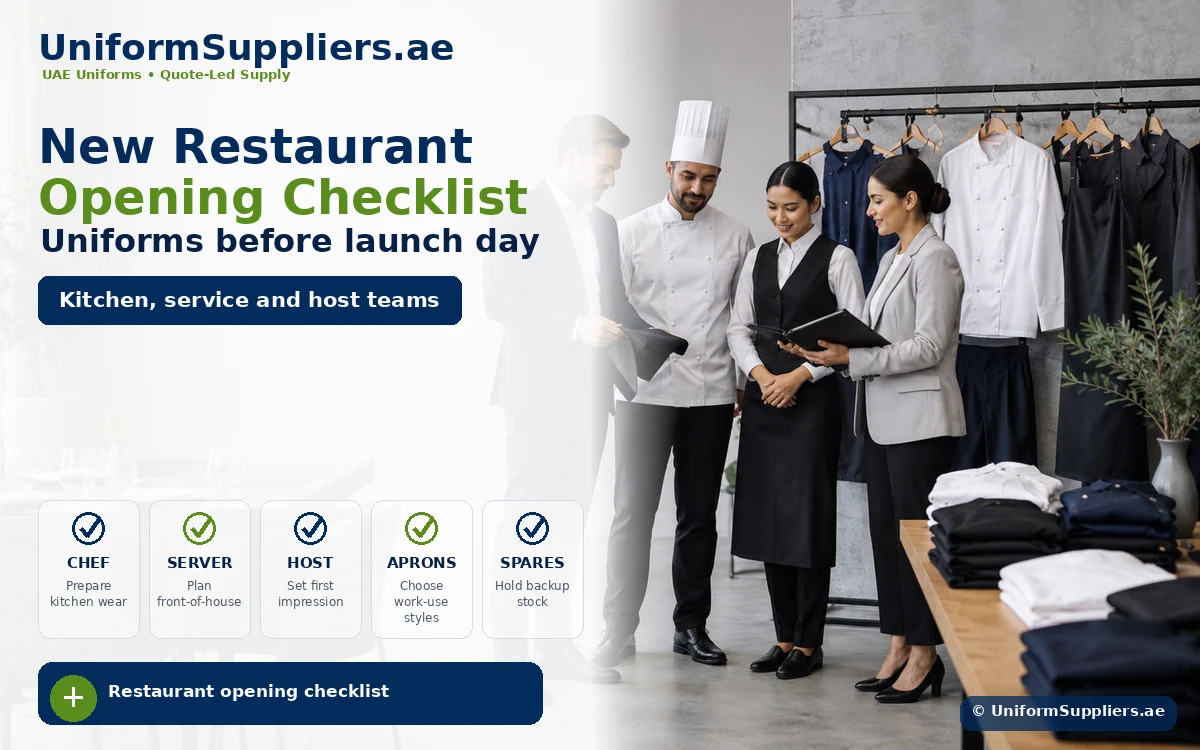
Opening a new restaurant means dozens of workstreams converging on a single date: fit-out, licensing, menu development, recruitment, and staff training all have to land before the doors open. Uniforms are easy to leave until the final weeks, yet they touch the most visible parts of the business — the servers and hosts guests see first, and the kitchen team behind them.
This checklist sets out a practical, restaurant-specific approach to planning uniforms for a new opening in the UAE: building the timeline backward from opening day, sizing a team still being hired right up to launch, and what genuinely needs to be in place on day one.
For a hotel-wide pre-opening uniform plan covering multiple departments, see the separate hotel uniform launch checklist. This article stays focused on restaurant front-of-house and kitchen roles.
What this guide covers
- Why uniforms need a place on the pre-opening timeline
- Working backward from opening day
- Front-of-house: servers, hosts and service uniforms
- Kitchen and chef wear
- Sizing runs for a team still being hired
- Branding and logo application lead considerations
- Opening-countdown checklist
- What should already be in place on day one
- Frequently asked questions
Why uniforms need a place on the pre-opening timeline
New restaurant openings in the UAE typically run on a fixed date driven by lease terms, marketing bookings, and investor expectations. Uniforms sit inside a schedule where almost everything else can slip a little. Leaving specification and ordering until the final fortnight puts pressure on every later step: sampling, sizing, branding and delivery all get compressed into less time than they need.
Front-of-house uniforms also do commercial work other pre-opening tasks do not. Servers and hosts are often the first brand touchpoint a guest experiences, before the food itself. A uniform that fits the concept, is comfortable through a full service shift, and looks consistent across the floor team contributes directly to the first impression the opening is designed to create.
Treating uniforms as a specification-and-procurement task with its own place on the opening timeline, rather than an afterthought once the menu and fit-out are settled, is the single biggest factor in avoiding a rushed or mismatched launch.
Working backward from opening day
The most reliable way to plan restaurant uniforms is to start from the confirmed opening date and work backward, rather than starting from “when can we order” and hoping it lands in time. In broad terms, the sequence runs: confirm concept and brand direction, finalise garment specification and colours, collect samples, size the team as it is hired, apply branding, then receive and distribute finished uniforms before service begins.
Each stage needs a realistic allowance of time and should not be assumed to be instant. Specification and colour approval can take longer than expected if decision-makers are also juggling fit-out and menu sign-off, and sampling benefits from being scheduled as a discrete step rather than squeezed around other pre-opening meetings. Because actual timing depends on garment type, quantity, customisation and current order volumes, final specification will be confirmed during quotation — this guide describes the sequence and planning discipline involved, not a promised number of days.
A practical rule for new restaurant projects: raise the uniform conversation with your supplier as soon as the brand identity and floor plan are reasonably settled, well before the final fit-out is complete, so specification, sampling and sizing can run alongside other pre-opening work rather than queued up behind it.
Front-of-house: servers, hosts and service uniforms
Front-of-house uniforms need to balance three things: brand alignment with the restaurant concept, comfort through long standing and walking shifts, and practicality for a UAE dining environment where air-conditioned interiors sit against hot outdoor terraces and valet or delivery points.
Typical front-of-house roles to specify separately include hosts and hostesses, servers, runners, bartenders and floor supervisors. Each role often needs a slightly different garment or accent — an apron style for servers, a more formal blazer or waistcoat for supervisors, a distinct colour or badge for management — while still reading as one coherent team from across the room.
Fabric choice matters more than it might first appear. Breathable, easy-care fabrics that hold colour and shape through frequent laundering suit the realistic wash frequency of a working restaurant, where uniforms may be laundered after every shift. For a deeper look at styling front-of-house teams, see restaurant staff uniforms that impress guests.
Because a new restaurant is, by definition, an unproven floor plan, it is worth ordering slightly more variety in accessory items (aprons, ties, name badges) than the exact headcount, so role assignments can shift in the first weeks of trading without a second procurement cycle.
Kitchen and chef wear
Kitchen uniforms are a parallel workstream with different priorities: heat resistance, hygiene, and durability under heavy daily use matter more than styling. A new restaurant kitchen typically needs chef jackets or coats differentiated by seniority, kitchen trousers, aprons suited to each station, and headwear appropriate to food safety requirements.
This guide does not go into kitchen wear specification in depth, since it is covered in full in chef wear and kitchen uniforms — the complete UAE guide. The point for a new opening is to treat kitchen wear as its own line item on the same backward-planned timeline as front-of-house, sized and branded on the same schedule, rather than assuming it can be sourced at the last minute because it is “just kitchen whites.”
Sizing runs for a team still being hired
New restaurants face a sizing challenge established venues rarely deal with: the team is often still being recruited in the weeks before opening, and headcount and individual sizes are not fully known until close to launch. Planning a sizing run for a team that does not yet fully exist needs a different approach to a straightforward reorder for an existing staff list.
A workable method is to build the size run in two passes. The first covers confirmed hires — management, key kitchen roles, and staff transferred from another outlet — sized individually as soon as confirmed. The second covers roles still being recruited, ordered against a typical size curve, with individual measurement scheduled once remaining hires are confirmed.
Booking an onsite measurement session for the confirmed team early, rather than waiting for the full roster, keeps sizing moving in parallel with recruitment instead of behind it. See the onsite measurement service for how sessions are arranged, and sizing and measuring a team for how records are kept for future top-up orders.
Mustang recommendation: for a new restaurant opening, request free samples against a confirmed LPO before committing to full production quantities, so fit, fabric and colour can be checked on real staff before the bulk order.
Branding and logo application lead considerations
Branding is frequently the step that gets compressed when a restaurant opening timeline slips. Embroidery or printing a new logo onto garments happens after the base garments are confirmed and sized, so any delay earlier in the process directly shortens the time available for branding.
New restaurant logos are also, by definition, unproven on fabric. A design that looks sharp on a menu or signage may need simplification to embroider or print cleanly at the small scale used on a shirt pocket or apron. Requesting a free digital logo mock-up before production begins lets the restaurant approve exactly how branding will look on the actual garment, rather than discovering an issue after a full run has already been branded.
Building in a distinct branding-and-approval stage — separate from garment sourcing and separate from sizing — is the most effective way to protect the final weeks before opening from a last-minute rebrand or reprint.
Opening-countdown checklist
The list below sets out the sequence in broad terms. It is a planning structure, not a guaranteed timeline — actual pacing depends on garment complexity, quantities and how quickly decisions and approvals move.
| Stage | What happens | Who is involved |
|---|---|---|
| Early planning | Confirm brand direction, colours and role list; open the conversation with your supplier | Owner/GM, design lead |
| Specification | Finalise styles, fabrics and quantities per role; request samples against a confirmed LPO | GM, uniform supplier |
| Sampling and approval | Approve samples on real staff where possible; confirm sizing method | GM, HR, supplier |
| Sizing — confirmed hires | Book onsite measurement for management and early-confirmed staff | HR, supplier |
| Branding approval | Approve digital logo mock-up for placement and size | Owner, supplier |
| Production | Bulk order placed against confirmed specification and sizing | Uniform supplier |
| Sizing — later hires | Measure and top up sizes for staff confirmed closer to opening | HR, supplier |
| Delivery and distribution | Uniforms checked employee-by-employee and distributed with badges | GM, HR |
| Opening week | Full front-of-house and kitchen team in complete uniform | Whole team |
What should already be in place on day one
By opening, the following should be settled: complete, correctly sized uniforms for every confirmed staff member across front-of-house and kitchen; branding applied and checked for placement and quality; name badges and accessories distributed; and a record of each employee’s specification kept on file for future reordering.
Stored repeat-order specification records mean replacing a damaged garment, sizing a new hire, or ordering a top-up later does not mean starting the specification process from zero.
If a role remains unfilled at opening — common for new restaurants — a short-term plan, such as a slightly larger size run or ready-stock items held back, keeps the visible floor team looking complete even if the roster is not yet final.
Frequently asked questions
How far ahead of opening should we start planning uniforms?
Start the conversation with your uniform supplier as soon as the brand identity and floor plan are reasonably settled, rather than waiting for the fit-out to finish. Specification, sampling, sizing and branding all take real time, and starting early lets these steps run alongside other pre-opening work instead of being squeezed into the final weeks.
What if we haven’t hired the full team yet?
This is normal for new openings. Plan sizing in two passes: measure confirmed hires as soon as they are available, and order remaining roles against a size curve, with fit checks scheduled once later hires are confirmed. An onsite measurement session can be booked for whichever staff are confirmed at the time.
Do front-of-house and kitchen uniforms need to be ordered together?
They can be planned on the same backward-built timeline and quoted together for efficiency, but they are functionally separate items — different fabrics and different priorities, styling versus heat resistance and hygiene. Treat them as two coordinated workstreams rather than one order.
Can we get samples before committing to a full order?
Yes. Free samples are available against a confirmed LPO, allowing the restaurant to check fit, fabric and colour on real staff before committing to full production quantities — a useful safeguard for a new concept where nothing has yet been tested in daily service.
What happens if our opening date moves?
A shifted opening date affects every step of the uniform timeline. Flag any date change to your uniform supplier as early as possible so sampling, sizing and branding stages can be rescheduled rather than compressed.
How do we handle uniforms for staff hired after opening?
Keeping stored specification records from the original order means new hires can be sized and matched to the existing programme without re-specifying garments from scratch, whether that happens in week one or months later.
Planning a restaurant opening?
Uniform Suppliers UAE, part of Mustang Advertising Trading LLC (Dubai, since October 2007), works with restaurant openings across the UAE on front-of-house and kitchen uniform programmes, from specification through to branded, sized delivery. For wider hospitality uniform sourcing, see the hospitality uniforms UAE pillar. To start planning, request a quote.