Special offers: free digital logo mock-up and free samples against a confirmed LPO. View offers


The Complete Guide to Hi-Vis and Reflective Workwear

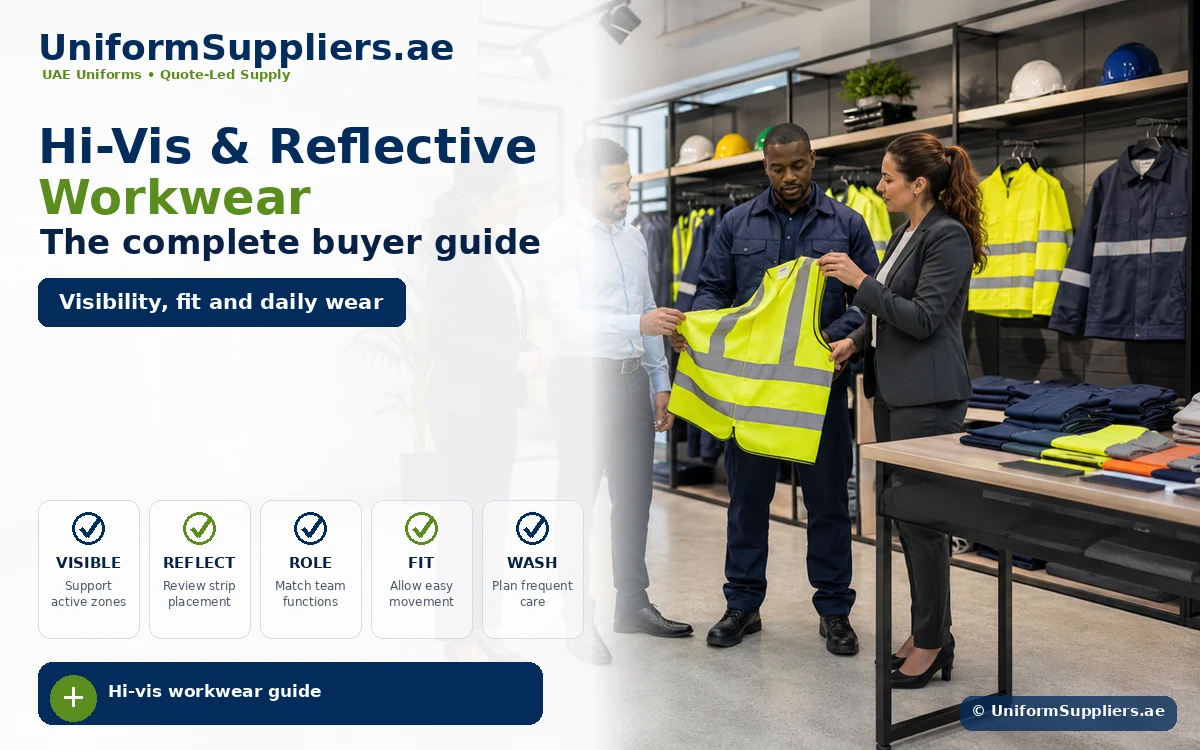
Hi-visibility clothing is one of the most misordered items in UAE procurement. A tender line that simply says “hi-vis vest” leaves the class, tape layout and intended use unspecified, and what arrives may be entirely wrong for a roadside or airside task where visibility genuinely determines whether a worker is seen in time.
This guide explains hi-visibility classification in generic terms, how reflective tape placement affects real-world visibility, why Gulf heat, laundering and UV exposure shorten the useful life of retroreflective garments, and which UAE roles typically need which level of hi-vis. For the broader hazard-mapping framework covering industrial workwear generally, and what documentation to demand from a supplier, see our complete guide to industrial workwear in the UAE; this article focuses specifically on hi-vis and reflective classification.
What this guide covers
- What hi-visibility clothing actually does
- Hi-vis classes explained: background material and reflective area
- Class comparison table
- Reflective tape placement and why layout matters
- Day visibility vs night and low-light visibility
- Heat, UV and laundering: why retroreflection fades
- Hi-vis care and replacement checklist
- Combining hi-vis with flame-resistant garments
- Which UAE roles typically need hi-vis
- Mustang recommendation
- Frequently asked questions
- Specifying hi-vis in your next quotation
What hi-visibility clothing actually does
Hi-visibility garments work through two separate mechanisms. A fluorescent background material makes the wearer stand out in daylight by reflecting more visible light than ordinary fabric, which matters most at dawn, dusk and in overcast or dusty conditions. Retroreflective tape returns light directly back toward its source, which is what makes a wearer visible in vehicle headlights at night. Both elements are needed for round-the-clock visibility: strong background colour with weak tape performs poorly after dark, and strong tape with little fluorescent area is unremarkable in daylight. Specifying both properties, not just “hi-vis” as a general description, is the starting point for getting the right garment.
Hi-vis classes explained: background material and reflective area
EN ISO 20471 is the standard most UAE tenders reference for high-visibility clothing for professional use. It groups garments into classes based on the minimum area of fluorescent background material and the minimum area of retroreflective tape a garment carries, with higher classes requiring more of both.
In generic terms, Class 1 covers the smallest area of background and reflective material and suits lower-risk environments with separation from traffic. Class 2 sits in the middle, with more material and coverage, suited to moderate-risk settings. Class 3 requires the largest area, generally achieved through a jacket-and-trouser combination or a coverall, and suits higher-risk situations such as work close to fast-moving traffic.
This is a structural explanation of what the standard covers, not a claim that any specific Mustang-supplied garment is certified to it. Ask your supplier to confirm the class and supporting test evidence on the product datasheet before you order.
Class comparison table
| Class (EN ISO 20471 structure) | Typical use context | Relative material coverage | What to confirm on the datasheet |
|---|---|---|---|
| Class 1 | Lower-risk areas with some separation from vehicle traffic, such as controlled yards or low-speed internal roads | Smallest area of fluorescent background and reflective tape | Whether the separation and speed at your site actually justify the lowest class |
| Class 2 | Moderate-risk settings such as warehouse yards, car parks, and general site work with some vehicle movement | Increased fluorescent and reflective area compared with Class 1 | Garment type (vest, shirt or coverall) needed to reach the class in practice |
| Class 3 | Higher-risk situations near fast-moving traffic, road works, and roles needing maximum visibility from any angle | Largest area of fluorescent and reflective material, often needing a two-piece or coverall combination | Whether a single garment reaches Class 3 or whether it depends on wearing it with another certified item |
Reflective tape placement and why layout matters
Class defines how much reflective material a garment carries; layout determines whether that material actually works. Tape positioned around the torso and over the shoulders creates a visible outline from multiple angles, including from the side, which a chest-only strip does not provide. Tape on the arms and legs helps a driver or plant operator judge the wearer’s posture and movement, not just their location, which matters when someone is bending or crouching near machinery. Continuous banding that wraps the body reads more clearly at a distance than short or broken segments, and layout gaps are a common reason a garment technically meets a class on paper but reads poorly in practice.
When comparing garments, check the tape width and placement described on the datasheet against the class claimed, and ask your supplier to confirm both rather than judging visibility by eye in a showroom.
Day visibility vs night and low-light visibility
Daytime visibility relies mainly on the fluorescent background colour standing out against typical site backgrounds — sand, concrete, vehicles and other workers. Fluorescent orange and yellow-green are the common choices because they contrast strongly with most UAE site environments in daylight.
Low-light and night visibility relies almost entirely on the retroreflective tape catching and returning headlight or spotlight beams. A worker can be adequately visible by day in a garment with modest tape and still be effectively invisible after dark if that tape has degraded or the layout leaves gaps. Roles working dawn, dusk or night shifts — road crews, airside staff, security patrols — need the reflective element treated as the primary specification.
Heat, UV and laundering: why retroreflection fades
Gulf conditions are hard on hi-vis garments in ways temperate-climate specifications do not always anticipate. Intense UV exposure across long daylight hours degrades fluorescent dye faster than in cooler markets, dulling the background colour well before the fabric itself wears out.
Commercial and hot-climate laundering compounds the problem. High wash temperatures, strong detergents and frequent cycles — driven by heat, sweat and dust — gradually abrade the microscopic glass beads or prism structure that make retroreflective tape work, reducing how much light it returns even when the tape still looks intact to the eye. Dust is a further factor: fine particulate works into the tape surface and can dull performance between washes, not only through washing itself. The practical implication is that a garment’s visible condition is not a reliable guide to its retroreflective performance, so replacement needs to be set on a schedule rather than on appearance alone.
Hi-vis care and replacement checklist
- Wash according to the garment’s care label, not the general uniform load, since reflective tape and fluorescent dye can be more sensitive to temperature and chemistry than the base fabric.
- Inspect tape after every few wash cycles for cracking, lifting at the edges or a duller surface, not just at issue and annual review.
- Check fluorescent colour against a reference garment periodically; fading is gradual and easy to miss without a comparison point.
- Set a replacement cycle by role and exposure, not visible failure — a road crew garment laundered and UV-exposed daily needs a shorter cycle than an occasional-use visitor vest.
- Keep visitor and pool stock rotated so garments are not left folded in daylight-exposed storage, which also degrades fluorescent dye.
- Record issue dates per employee so replacement can be tracked against wear rather than guessed at.
Combining hi-vis with flame-resistant garments
Some UAE roles face both a visibility hazard and a flame or heat hazard at once — certain oil and gas, utilities and hot-work environments. Where that overlaps, the garment needs to deliver both properties together, generally through a fabric and construction rated for both hi-vis and flame resistance rather than layering a standard hi-vis vest over FR clothing, which can compromise the FR protection. This article does not cover flame-resistant specification in depth; see our dedicated guide on flame-resistant workwear for oil and gas teams, and confirm with your supplier that any combined garment carries evidence for both properties on the same datasheet.
Which UAE roles typically need hi-vis
Traffic marshals and roles directing vehicle movement on site typically need the highest visibility available, since their job depends on being seen instantly by drivers. Logistics and warehouse yard staff working around forklifts, trucks and reversing vehicles need reliable daytime and low-light visibility across a full shift, including early morning and evening. Road and utility crews working near live traffic are usually the clearest case for the higher end of hi-vis specification, particularly where work continues into dusk or night. Airside and ground handling staff need hi-vis that performs reliably in a fast-moving, multi-vehicle environment with strict identification requirements. Across all of these roles, the right specification starts with the task and lighting conditions, not a single default vest ordered for the whole site.
Mustang recommendation
Specify hi-vis by class, tape layout and garment type for each role, and separate the daytime fluorescent requirement from the low-light reflective requirement, since they are answered by different parts of the garment. Set a replacement cycle based on laundering frequency and UV exposure rather than visible wear.
Uniform Suppliers UAE, part of Mustang Advertising Trading LLC and operating in Dubai since October 2007, supplies PPE and safetywear as part of wider industrial uniform programmes, alongside ready-stock supply for urgent cover, and stores repeat-order specifications so hi-vis reorders match the original class and layout. Uniform Suppliers UAE does not claim certification on its own behalf; where a certified hi-vis class is required, state it in your enquiry and it will be addressed at quotation. Final specification will be confirmed during quotation.
Frequently asked questions
What is the difference between Class 2 and Class 3 hi-vis?
The classes differ in the minimum area of fluorescent background material and retroreflective tape a garment carries, with Class 3 requiring the most of both. Class 3 is often reached through a two-piece combination or coverall rather than a single vest. Confirm with your supplier which garment combination reaches the class you need.
Why does reflective tape stop working even when it still looks fine?
Retroreflective tape relies on a microscopic glass bead or prism structure that returns light to its source. Repeated hot laundering, UV exposure and dust abrasion degrade that structure well before the tape shows obvious visible damage, so appearance is not a reliable guide to performance. Set replacement cycles by exposure and wash frequency rather than by eye.
Can one hi-vis garment work for both day and night shifts?
Yes, provided it carries sufficient fluorescent background area for daytime contrast and sufficient, well-placed retroreflective tape for night performance. A garment strong in one and weak in the other will underperform, so check both properties are specified, not just the class number.
Do hi-vis garments need to be replaced on a fixed schedule?
A fixed schedule is more reliable than waiting for visible failure, because retroreflective performance degrades before a garment looks worn out. The right interval depends on laundering frequency, UV exposure and role; a garment laundered daily outdoors needs a shorter cycle than an occasional-use visitor vest kept in storage.
Can hi-vis and flame-resistant properties be combined in one garment?
Yes, where a role faces both hazards, a garment can be constructed to deliver both properties together. Confirm this on the supplier’s datasheet as a combined specification rather than assuming it by layering a standard hi-vis vest over separate FR clothing, which can compromise the FR performance.
Which UAE roles need the highest hi-vis class?
Roles closest to fast-moving vehicle traffic, in low light, or directing traffic generally need the highest class available — traffic marshals, road and utility crews, and airside ground staff are common examples. Roles in lower-risk, more separated environments can often work safely at a lower class, but this should be assessed per site.
Specifying hi-vis in your next quotation
Bring the class needed, the roles and shift patterns involved, and the expected laundering frequency, and hi-vis garments can be quoted and sampled against a real specification. See also construction and engineering and warehousing and logistics, where hi-vis is a standard part of the kit.
Request a quote with your hi-vis class, role list and shift pattern attached.