Special offers: free digital logo mock-up and free samples against a confirmed LPO. View offers
Corporate Accessories: Ties, Scarves and the Finishing Details of a Professional Uniform

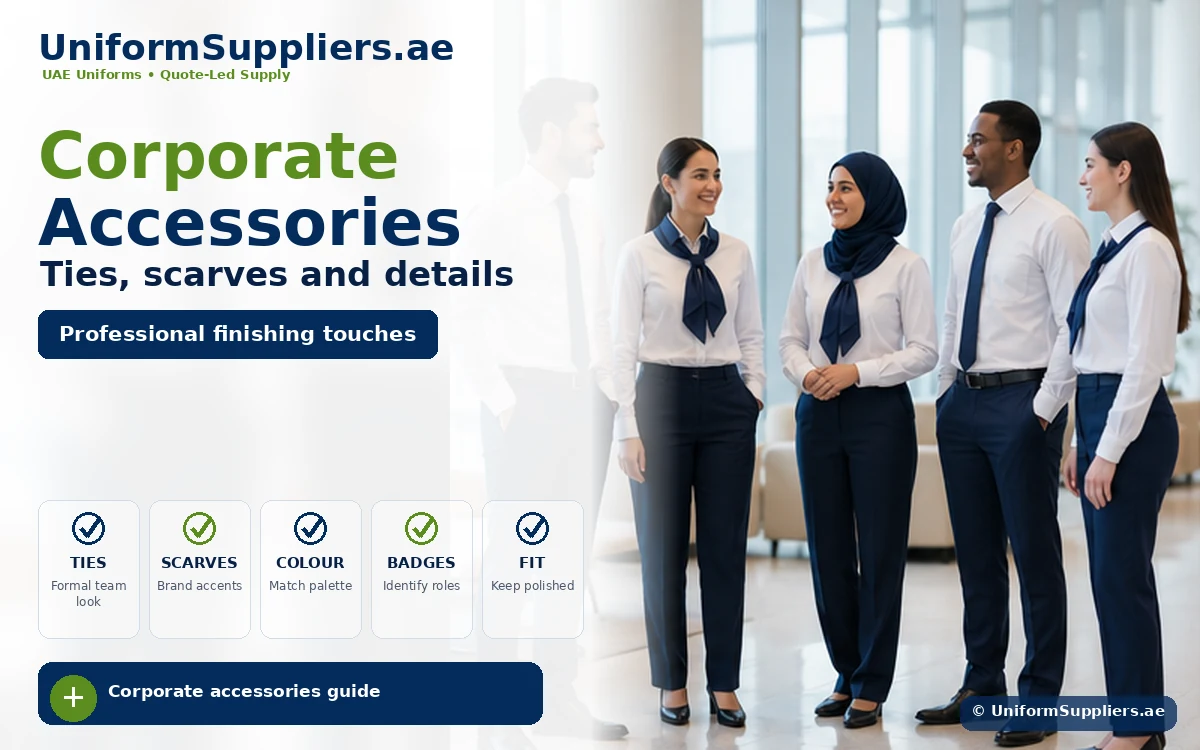
Ties, scarves, waistcoats and pocket squares rarely get their own line item on a uniform brief. They usually turn up as an afterthought once the shirts and blazers are approved. But for front-of-house, reception, banking and hospitality teams, these small pieces are often what a customer notices first and remembers longest. This guide sets out how UAE businesses can plan corporate accessories as a deliberate part of the uniform programme, rather than a last-minute add-on.
Table of Contents
- Why Accessories Matter More Than Their Cost Suggests
- Ties: Width, Pattern and Practicality
- Scarves: Fabric, Drape and Climate
- Waistcoats: When They Earn Their Place
- Building a Gender-Inclusive Accessory Set
- Branding Accessories Without Overdoing It
- Comparison: Accessory Options by Role
- Checklist: Briefing an Accessory Range
- FAQs
Why Accessories Matter More Than Their Cost Suggests
A tie or scarf occupies a small area of fabric compared with a shirt or blazer, but it sits at eye level in almost every customer interaction. Reception desks, boardroom greetings, cabin crew style hospitality roles and bank counters are all conversations conducted at close range, and a well-chosen accessory does a disproportionate amount of work in signalling professionalism and brand consistency. Conversely, a tie that clashes with the shirt palette, or a scarf that has gone limp after a few washes, undermines an otherwise well-specified uniform.
Because accessories are inexpensive relative to garments, they are also one of the easiest places to refresh a look between full uniform cycles. A new tie pattern or scarf colourway can update a brand’s front-of-house presentation without the cost of reissuing shirts and blazers across the team.
Ties: Width, Pattern and Practicality
Tie width should follow the cut of the shirt collar and blazer lapel it is paired with — a narrow tie looks out of proportion against a wide-lapel blazer, and a wide tie can overwhelm a slim-fit shirt. Most UAE corporate programmes settle on a mid-width tie (around 7–8 cm) as a safe, timeless default that works across body types and roles.
Pattern choice matters more than most buyers expect. A single, consistent tie pattern across the team reads as coordinated; a mix of stripes, solids and small motifs across the same department reads as inconsistent, even if each individual tie is attractive. Solid colours in the brand palette, or a subtle woven texture, are the lowest-risk options for teams where consistency matters most, such as reception and client-facing sales.
Practicality also matters. Self-tie ties require staff to tie them correctly and consistently, which is not guaranteed across a large or high-turnover team. Pre-tied or clip options remove that variability and are worth considering for roles where a consistently neat knot matters more than individual styling — such as retail counter staff or event crews.
Scarves: Fabric, Drape and Climate
Scarves face a different set of trade-offs than ties. Fabric choice affects both how the scarf drapes and how it performs indoors in UAE air conditioning versus a brief walk between an entrance and a reception desk. A silk-look polyester scarf drapes well and holds its print, while a lighter chiffon-style fabric can look elegant but may require more careful tying to sit correctly through a working shift.
Printed scarves are one of the most effective ways to carry brand colours and even a subtle logo motif into a uniform without adding a separate branded item. A repeating pattern using two or three brand colours, rather than a literal logo print, tends to age better and feels less like a temporary campaign piece and more like a permanent uniform element.
For hospitality and healthcare-adjacent front-of-house roles, easy-care fabric that tolerates repeated washing without losing its print or drape is worth prioritising over a scarf that looks best on day one but degrades quickly. Final fabric specification will be confirmed during quotation based on the intended wear pattern.
Waistcoats: When They Earn Their Place
Waistcoats add a layer of formality that suits banking, fine-dining and premium hospitality roles, but they add cost, a fitting variable and — in a hot climate — a comfort consideration for any role that involves standing for long shifts or moving between air-conditioned and outdoor spaces. They tend to work best as an occasional-use or premium-tier accessory rather than a default for every role in a programme.
Where a waistcoat is specified, it should be sized and fitted with the same rigour as a blazer — a loose or overly snug waistcoat looks unfinished no matter how good the shirt and tie underneath it are. Teams considering waistcoats for the first time often benefit from a short trial period with a small group before committing to a full rollout; see our guide to sampling before you order.
Building a Gender-Inclusive Accessory Set
A modern corporate accessory range should offer equivalent options across genders rather than defaulting to ties for men and scarves for women. Many UAE businesses now offer both tie and scarf options to any team member regardless of gender, along with a neutral pin or brooch alternative for staff who prefer a minimal accessory. Offering a genuine choice, documented once in the uniform policy, avoids awkward one-off exceptions later and signals a considered, inclusive approach to staff.
If your business does not yet have a written uniform policy covering choices like this, our guide on writing a uniform policy for your UAE company covers how to document accessory options clearly.
Branding Accessories Without Overdoing It
Accessories are an easy place to over-brand a uniform. A tie clip, scarf print and pocket square all carrying the same logo can look busy rather than polished. A cleaner approach is to choose one accessory as the primary brand carrier — commonly the scarf print or a subtle tie clip — and keep the rest in coordinating solid colours. This also keeps replacement costs manageable, since a plain solid tie is far easier to restock consistently than a printed one that may be discontinued by a supplier.
Sourcing and Reordering Considerations
Accessories tend to have a shorter effective lifespan than shirts or blazers, since ties and scarves show wear at knots and fold lines faster than a garment worn under a jacket. Planning for a higher replacement rate on accessories than on core garments, from the outset, avoids a mismatched look developing gradually as some staff replace worn items ahead of others.
Because accessories are small and relatively low-cost per unit, some UAE businesses choose to hold a modest buffer stock centrally — enough for a handful of replacements — rather than triggering a full reorder process every time one item wears out. This works well for solid-colour ties and scarves that are unlikely to be discontinued, but is less reliable for a printed or custom-woven design, where a supplier may need meaningful notice to reproduce a small quantity. If your accessory range includes a printed or woven design, it is worth asking your supplier at the outset how reorders of small quantities are typically handled, so there are no surprises later.
Sample fit and fabric before committing to a full order is equally important for accessories as for garments. A scarf that photographs well on a supplier’s swatch card can behave differently once tied and worn for a full shift — checking drape, print sharpness and colour match against existing shirts and blazers in person avoids a costly reissue. Our uniform sampling service covers accessories alongside garments for exactly this reason.
Comparison: Accessory Options by Role
| Role type | Typical accessory | Priority |
|---|---|---|
| Reception / front desk | Tie or printed scarf | Consistency, brand colour |
| Banking / finance counter | Tie, optional waistcoat | Formality |
| Premium hospitality | Waistcoat, tie or scarf | Formality, comfort under shift length |
| Retail / customer service | Pre-tied tie or simple scarf | Ease of consistent wear |
| Event / promotional crew | Branded scarf or pocket square | Brand visibility |
Checklist: Briefing an Accessory Range
- Confirm which roles require an accessory and which are optional
- Decide on one primary brand carrier (scarf print, tie clip or colour) rather than branding every piece
- Offer equivalent tie and scarf options across genders, plus a neutral alternative
- Match tie width to collar and lapel proportions already specified for shirts and blazers
- Request fabric samples before committing to a full order — see our sampling service
- Document the approved accessory options in your written uniform policy
FAQs
Do all staff need to wear the same tie or scarf pattern?
Most UAE businesses standardise on one pattern or colourway per role or department for a consistent look, though some allow limited variation within an approved palette. Final specification will be confirmed during quotation.
Can accessories be reordered separately from the main uniform?
Yes. Because accessories are a small, low-cost item, most businesses treat them as an easily reorderable component rather than part of the main garment cycle. Speak with your account contact about setting up a simple reorder process.
Should accessories be washable or dry-clean only?
Easy-care, washable fabrics are generally preferred for accessories worn daily, since dry-clean-only items add cost and logistics for staff. Silk-look polyester options offer a similar appearance with easier care.
How do we choose between a tie clip and a printed scarf for branding?
It depends on your existing brand assets — a distinctive brand colour or pattern lends itself well to a scarf print, while a simple wordmark or icon logo often works better as a subtle tie clip or pin. We can advise during your quotation.
Do accessories need to match across all branches of a multi-branch business?
Most multi-branch UAE businesses standardise accessories across all locations to protect brand consistency, even where garments vary slightly by role. Because accessories are small and easy to distribute, they are one of the simpler items to keep uniform network-wide — see our related guide on choosing uniforms for multi-branch retail.
What happens if an accessory design is discontinued by the fabric or trim supplier?
This is a real risk with printed or custom-woven accessories, since the specific fabric roll or weave used may not always be available for reorder in future. Choosing a design built from standard, repeatable colours and patterns — rather than a one-off print run — reduces this risk. Your account contact can flag any discontinuation risk at the point of order.
Ready to plan a coordinated accessory range for your team? Request a quote and our team will help you match ties, scarves and waistcoats to your existing corporate uniform specification.