Special offers: free digital logo mock-up and free samples against a confirmed LPO. View offers
Uniforms for the UAE Oil, Gas and Energy Sector: A Complete Industry Guide

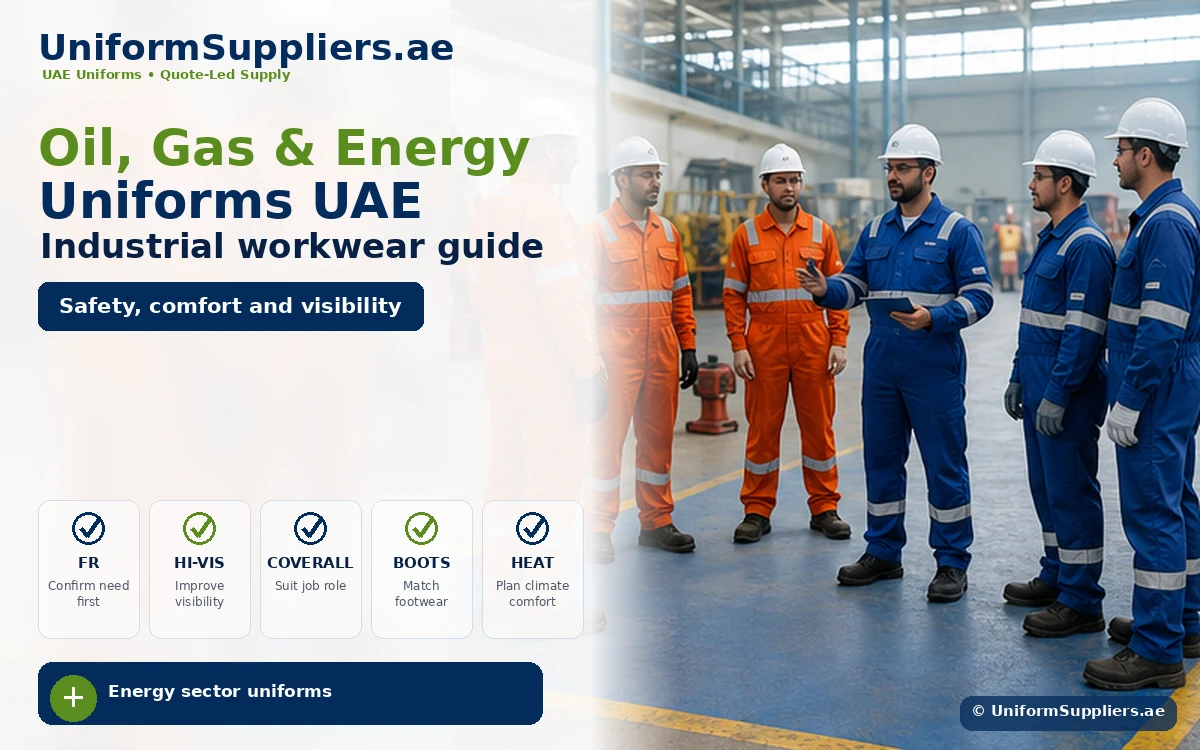
Oil, gas and energy sites in the UAE run some of the toughest uniform requirements in the country — extreme heat, flame and chemical exposure risk, strict site-access rules, and large, often multi-contractor workforces that all need to be identifiable at a glance. A uniform programme built for this sector has to solve for safety compliance, durability and workforce identification at the same time, which makes it a more complex brief than most other industries.
This guide covers what UAE oil, gas and energy operators and their contractors typically need to consider when building a workwear programme for site teams.
In this guide
- Why energy-sector uniforms are a distinct category
- Core garments for energy-sector site teams
- Flame-resistant fabric basics
- Workforce identification for multi-contractor sites
- Managing heat stress in UAE energy-sector uniforms
- Procurement considerations for EPC and site contractors
- Energy-sector uniform checklist
- FAQ
Why energy-sector uniforms are a distinct category
Most industrial uniform programmes balance durability and comfort. Energy-sector programmes add a third, non-negotiable factor: protection against flame, arc flash or chemical exposure risk, depending on the specific role and site zone. This changes fabric selection, garment construction and even laundering rules, and it means uniform decisions on an energy site typically involve safety and HSE teams alongside procurement, not procurement alone.
Core garments for energy-sector site teams
Workwear needs vary by role and site zone, but most UAE energy-sector programmes are built around a similar core set:
- Coveralls or two-piece FR sets — the standard base layer for site-facing roles in flame-risk zones.
- Flame-resistant work shirts and trousers — for roles where a full coverall isn’t practical but FR protection is still required.
- High-visibility layers — worn over or integrated with FR garments in vehicle-traffic or heavy-machinery areas.
- Safety footwear — typically role-specific, matched to the site’s own safety requirements.
- Office and site-support uniforms — for admin, control-room and non-hazard-zone staff, usually a standard corporate or industrial uniform rather than FR-rated wear.
Final garment specification for any FR or safety-rated item should always be confirmed against your site’s own HSE requirements and the applicable role-specific standard — this guide is a planning overview, not a substitute for your site’s safety documentation.
Flame-resistant fabric basics
Flame-resistant fabrics are engineered to self-extinguish and limit burn injury in a flash-fire or arc-flash event, and they lose this protective performance if washed or treated incorrectly over repeated use. A few practical points worth knowing when specifying or maintaining FR uniforms:
- FR treatment can be inherent to the fibre or applied as a finish — the two behave differently over the garment’s lifespan, and this affects wash and replacement guidance.
- Certain detergents, bleach and fabric softeners can degrade FR performance over time — any laundry contractor handling FR garments should be briefed on this specifically.
- FR garments should be replaced when visibly damaged, heavily contaminated with flammable substances, or once they no longer meet the visual and physical condition your site’s safety policy requires.
We supply FR fabric options and can talk through the practical differences during quotation — any certification or standards claim for a specific FR fabric should be verified directly against the manufacturer’s documentation for your project.
Workforce identification for multi-contractor sites
Large energy sites often have several contractors and subcontractors working simultaneously, which makes clear visual identification a genuine safety and access-control issue, not just a branding preference. Colour-coded uniforms or high-visibility accessories by contractor or role, combined with clear ID badges, help site supervisors quickly identify who is authorised in which zone. This is worth planning at the same time as the core garment brief, rather than adding identification as an afterthought once uniforms are already in production.
Managing heat stress in UAE energy-sector uniforms
UAE summer heat combined with mandatory FR or heavy-duty PPE layers creates a genuine heat-stress risk for outdoor site teams. Fabric weight, weave and moisture-management finishes all affect how much heat load a garment adds on top of ambient temperature, and this is a factor worth discussing directly with your fabric supplier rather than defaulting to the heaviest, most protective-looking option by instinct. Site rotation schedules, hydration policy and rest-break planning sit alongside uniform choice as part of an overall heat-management approach, and uniform selection should be considered as one part of that wider plan, not a replacement for it.
Procurement considerations for EPC and site contractors
EPC contractors and site operators typically need a uniform supplier who can handle multi-site delivery, consistent sizing across a large and changing workforce, and fast reordering as crews rotate on and off site. Centralising uniform procurement through one supplier relationship — rather than each contractor sourcing independently — tends to produce more consistent identification and easier compliance tracking across the site. Request a quote to talk through your site’s specific programme requirements.
Aligning uniform issue with site induction
On most UAE energy sites, no one is permitted onto the working area without completing site induction, and uniform issue naturally sits alongside that process. Building uniform sizing and issue into the induction schedule — rather than treating it as a separate logistics step that happens whenever a contractor gets around to it — avoids the common bottleneck of a worker completing induction but being held back from starting work because the correct FR or safety garment isn’t yet available. For large mobilisation periods, where dozens or hundreds of contractor personnel may be inducted over a short window, having sizing captured in advance through a simple pre-mobilisation form makes a meaningful difference to how smoothly the uniform side of onboarding runs.
Durability and total lifecycle on site
Energy-sector uniforms typically see harder daily use than almost any other uniform category — exposure to dust, grease, UV and repeated heavy-duty laundering all shorten garment life faster than in an office or retail setting. Reinforced stitching at stress points, higher-grade zips and fastenings, and fabric weights suited to the specific role all affect how long a garment holds up under this kind of use. Because replacement frequency has a direct cost and logistics impact across a large workforce, it’s worth discussing expected garment lifespan for your specific site conditions during quotation, rather than assuming all industrial-grade fabric performs the same way under heavy field use.
Energy-sector uniform checklist
| Consideration | What to confirm |
|---|---|
| Zone requirements | Which roles need FR, high-visibility or standard workwear |
| Fabric specification | Confirmed against your site’s HSE and safety standards |
| Laundering rules | FR-safe detergents and processes communicated to your laundry provider |
| Identification system | Colour-coding or badges for multi-contractor site access |
| Heat management | Fabric weight and finish considered alongside rotation/rest policy |
| Reordering process | |
| Reordering process | Fast, consistent reorder path as crews rotate on and off site |
What to bring to a quotation conversation
Energy-sector uniform quotations tend to move faster when the site’s own safety requirements are on hand from the start — the applicable FR or safety standard for each role, the roles and headcount by zone, expected laundering arrangement, and any existing identification or colour-coding system already in use across the site. With that information, fabric and garment options can be matched to your actual site conditions rather than working from general assumptions, which reduces the number of revision rounds needed to reach a final specification.
FAQ
Do all roles on an energy site need flame-resistant uniforms?
No — FR requirements are typically zone and role-specific, based on your site’s own HSE risk assessment. Office, admin and non-hazard-zone roles usually wear standard corporate or industrial uniforms instead.
How do we know which FR standard our uniforms need to meet?
This should be confirmed against your site’s own safety documentation and the standards your HSE team specifies for each role — we can supply against a specified standard once confirmed, but the applicable standard itself needs to come from your site’s own safety requirements.
Can FR uniforms be branded with a company logo?
Yes, though the branding method needs to be compatible with the fabric’s FR treatment — this is worth confirming during quotation so the branding process doesn’t affect the garment’s protective performance.
How often should FR workwear be replaced?
Based on visible condition, contamination and your site’s own safety policy rather than a fixed calendar interval — final guidance should follow your site’s HSE requirements.
Can one supplier handle uniforms for multiple contractors on the same site?
Yes, and centralising through one supplier relationship generally makes consistent sizing, identification and reordering easier to manage across a multi-contractor workforce.
How should uniform sizing be captured for a large contractor mobilisation?
A pre-mobilisation sizing form completed ahead of the induction date is the most reliable approach for large intakes, since it gives enough lead time to have correctly sized garments ready before workers arrive on site.
Do office-based energy-sector staff need the same uniform standard as field crews?
No — office, admin and control-room staff who don’t enter hazard zones typically wear a standard corporate or industrial uniform rather than FR-rated wear, based on your site’s own zoning and risk assessment.
What affects how long FR and industrial workwear lasts under heavy field use?
Fabric weight, stitching quality at stress points, and how the garment is laundered all affect lifespan. Discussing your specific site conditions during quotation helps set realistic expectations for garment durability and replacement planning.
Talk to us about your site’s uniform programme
We supply industrial and flame-resistant fabric options for UAE energy-sector teams, and can work with your HSE requirements to specify the right garments for each zone and role. See our industrial uniforms guide or read about flame-resistant workwear for oil and gas teams. Request a quote to discuss your site’s requirements.