
Blog
Textile and Uniform Manufacturing Certifications Explained: A Buyer’s Guide to OEKO-TEX, GOTS, ISO, WRAP and BSCI

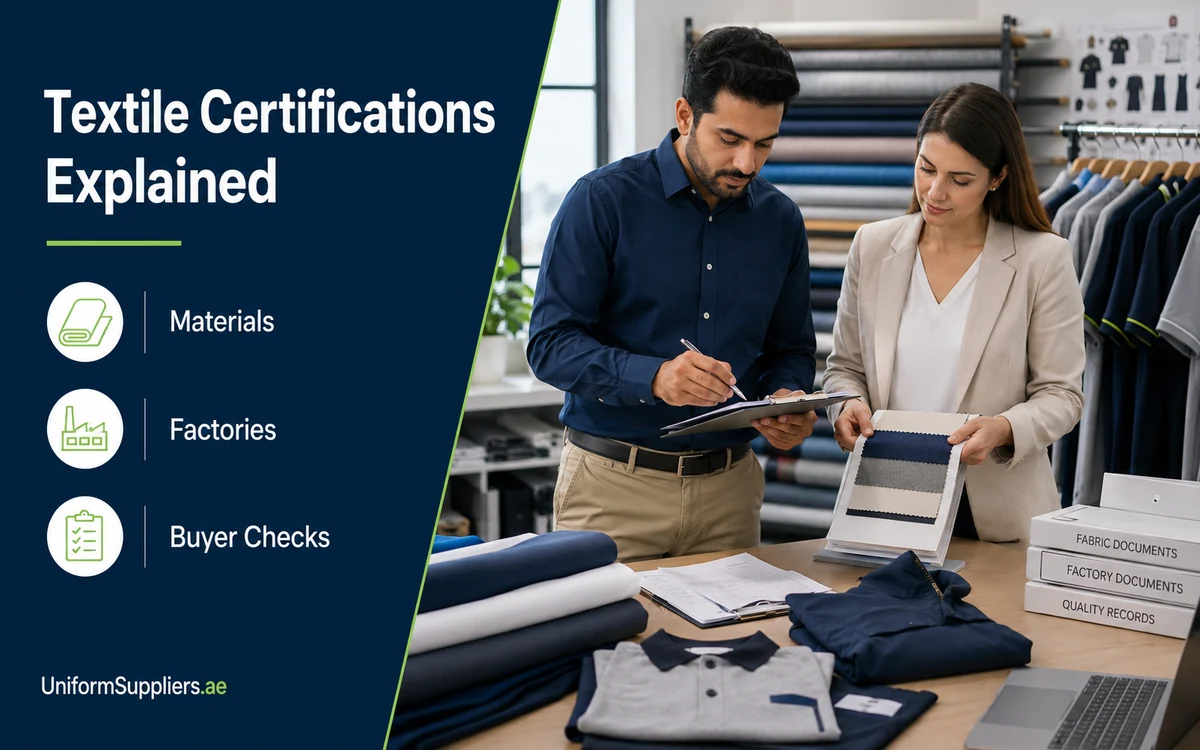
“Certified manufacturer” now appears in almost every uniform tender, hotel-opening brief and corporate procurement policy that lands on a UAE supplier’s desk. The trouble is that the phrase is used as if it means one thing, when it actually covers at least five separate, non-interchangeable systems: chemical-safety testing, sustainable-fibre chain of custody, factory quality management, ethical and social auditing, and protective-performance standards for safety workwear.
Treating these as interchangeable is how buyers end up accepting a certificate that does not answer the question their own tender asked. A factory can hold a spotless ISO 9001 quality certificate and have never been audited for working conditions. A fabric can be OEKO-TEX certified for harmful substances and still contain no organic or recycled fibre at all. Neither fact is a problem on its own — the problem is not knowing the difference when writing the specification.
This guide explains what each certification actually verifies, which body issues or accredits it, and how to check a supplier’s claim against the public record, plus the certifying and accreditation bodies relevant to India, China and Bangladesh — the three markets most GCC uniform programmes source from — and the worldwide bodies above them. For quick definitions of related terms, see our uniform and workwear manufacturing glossary.
What this guide covers
- What “certified” actually means when you’re buying uniforms
- Product-safety and chemical-testing certifications
- Sustainable-fibre and recycled-content certifications
- Quality and environmental management systems (ISO)
- Ethical and social-compliance certifications
- Safety-workwear performance standards to check separately
- Certifying and accreditation bodies by sourcing country
- How to verify a certificate before you commit an order
- Certification comparison at a glance
- Mustang recommendation
- Getting a certification-aware quote
- Frequently asked questions
What “certified” actually means when you’re buying uniforms
Before comparing schemes, it helps to sort them into families, because a buyer usually only needs one or two of these for a given project, not all five.
- Product safety and chemical testing — confirms a specific fabric or finished garment was tested against limit values for substances that could be harmful to the wearer.
- Sustainable fibre and chain of custody — confirms a claimed fibre content (organic, recycled, verified) is genuine and traceable through the supply chain, not just marketing language.
- Quality management systems — confirms a factory runs a documented, audited management process. It says the process is controlled; it does not, by itself, say anything about the safety of a specific product or the treatment of workers.
- Ethical and social compliance — confirms a factory was audited against a code of conduct covering wages, hours, health and safety, and working conditions.
- PPE performance standards — confirm a specific safety garment, tested to a named method, delivers a stated level of protection (visibility, heat resistance, cut resistance and so on).
One rule applies across all five families: a genuine certificate always names a specific holder — a company or a named facility — with a defined scope, a certificate number and an expiry date. A certificate is never held “by an industry” or “by a country.” If a supplier cannot produce that document with those details, treat the claim as unverified rather than assuming it is covered by a scheme mentioned somewhere on their website.
Product-safety and chemical-testing certifications
OEKO-TEX® STANDARD 100 is the certification most buyers mean when they say a fabric is “chemically safe.” It tests a specific article — a fabric, trim or finished garment from a named production run — against limit values for substances such as certain dyes, formaldehyde, heavy metals and other regulated chemicals, with stricter limits for products that sit closer to the skin (such as garments for infants). Certification is issued by an independent, accredited testing institute after laboratory testing, and each certificate is tied to that specific article rather than to the factory as a whole. See the standard directly at oeko-tex.com.
A related but different framework is the EU’s REACH chemical regulation, which restricts and requires disclosure of certain substances in products placed on the EU market. REACH compliance is a regulatory obligation, not a voluntary certificate with a logo, and buyers sometimes conflate the two. If chemical safety is a genuine requirement for your uniform programme — for example scrubs, chef wear or garments worn for long shifts against the skin — ask specifically for the OEKO-TEX certificate for the article you are ordering, not a general statement that the factory “follows international chemical standards.”
Sustainable-fibre and recycled-content certifications
These certifications verify a fibre claim through the entire supply chain, from raw material to the finished label, rather than testing the finished fabric for chemical safety.
The Global Organic Textile Standard (GOTS) covers organic fibre content and traces it through harvesting, processing, manufacturing and labelling, alongside minimum environmental and social criteria at each stage. Certification is issued by GOTS-approved certification bodies, and the standard publishes its own list of approved certifiers and certified suppliers, searchable at global-standard.org.
The Global Recycled Standard (GRS), Recycled Claim Standard (RCS) and Organic Content Standard (OCS) are administered by Textile Exchange and work on the same chain-of-custody principle applied to recycled or organic content rather than fully organic fibre: GRS adds environmental and social processing criteria on top of a recycled-content claim, while RCS and OCS verify the input-material claim itself. Details and the certified-facility directory are at textileexchange.org.
These matter most when a customer’s own sustainability policy specifies a fibre claim — for example a hotel group’s ESG programme requiring recycled-polyester uniforms, or a government tender asking for organic-cotton options. Without that specific requirement, this family of certification is not usually the right one to chase for a standard corporate or hospitality order.
Quality and environmental management systems (ISO)
ISO 9001 (quality management), ISO 14001 (environmental management) and ISO 45001 (occupational health and safety management) are the three ISO standards that come up most often in factory questionnaires. Each is issued by an independent certification body that is itself accredited by a national accreditation authority, and that accreditation is recognised internationally through the International Accreditation Forum’s multilateral recognition arrangement. The standards themselves are published by the International Organization for Standardization at iso.org.
The point buyers most often miss: these certificates confirm the factory’s management process is documented and audited — consistent production control, corrective-action handling, environmental procedures, health and safety management — not that any specific garment meets a chemical-safety or protective-performance standard. A factory can be a well-run, ISO 9001-certified business and still need a separate OEKO-TEX certificate for a specific fabric, or a separate EN test report for a specific PPE garment. Ask what each certificate actually covers rather than treating “ISO certified” as a catch-all answer.
Ethical and social-compliance certifications
This family answers a different question again: how the people making the garment are treated. All of the schemes below are facility-level, audit-based and time-bound, typically valid for one to three years, which is why the audit date on the certificate matters as much as the scheme name.
| Scheme | What it audits | Owned/administered by | Official reference |
|---|---|---|---|
| amfori BSCI | Working conditions against amfori’s Code of Conduct: wages, hours, health and safety, no child or forced labour | amfori (Business Social Compliance Initiative) | amfori.org |
| Sedex / SMETA | Four-pillar ethical audit: labour standards, health & safety, environment, business ethics | Sedex (Supplier Ethical Data Exchange) | sedex.com |
| WRAP | Facility-level certification against 12 principles covering labour, health & safety, environment and customs compliance | Worldwide Responsible Accredited Production | wrapcompliance.org |
| SA8000 | Certifiable social-accountability standard covering forced/child labour, health & safety, wages, hours and management systems | Social Accountability International (SAI) | sa-intl.org |
Sedex is worth a specific note: membership on the Sedex platform is not itself a certification, and a factory can be a Sedex member without having completed a SMETA audit. Ask specifically for a current SMETA audit report, not just confirmation of Sedex membership.
Safety-workwear performance standards to check separately
None of the factory-level certifications above tell you whether a specific safety garment protects against the hazard it is being bought for. That is a separate, product-level question answered by performance standards such as EN ISO 20471 (high-visibility clothing), EN ISO 11612 (heat and flame protection), EN 388 (mechanical protection for gloves), EN 166 (eye protection) and EN ISO 20345 (safety footwear). We cover hazard-to-garment specification and exactly what documentation to request for PPE in our industrial uniforms and safety workwear pillar page, our full industrial workwear safety guide, and our note on choosing safety shoes and boots. Treat factory certification and garment performance as two separate lines on your tender checklist, not one.
Certifying and accreditation bodies by sourcing country
Global schemes such as OEKO-TEX, GOTS, Textile Exchange, amfori, Sedex, WRAP and SAI operate through accredited certifiers and auditors worldwide, including in India, China and Bangladesh. Alongside them, each country has its own government or industry bodies worth knowing when you are reviewing a sourcing proposal or a factory’s paperwork.
India
- Ministry of Textiles, Government of India — the government department overseeing textile policy and the export promotion councils. texmin.nic.in
- Textiles Committee — a statutory body under the Ministry of Textiles that carries out textile testing, quality assurance and certification. textilescommittee.nic.in
- Apparel Export Promotion Council (AEPC) — the official export promotion body for India’s apparel sector; membership (RCMC registration) is generally required for garment exporters. aepcindia.com
- Texprocil (The Cotton Textiles Export Promotion Council) — the export promotion council specifically for cotton textiles. texprocil.org
- National Accreditation Board for Certification Bodies (NABCB) — India’s national accreditation body (part of the Quality Council of India), recognised under the IAF, which accredits the certification bodies that issue ISO certificates in India. nabcb.qci.org.in
China
- Certification and Accreditation Administration of the People’s Republic of China (CNCA) — the national government body overseeing China’s conformity-assessment system. english.cnca.gov.cn
- China National Accreditation Service for Conformity Assessment (CNAS) — the national accreditation body that accredits the testing laboratories and certification bodies operating in China, including for textile standards. cnas.org.cn/english
- China National Textile and Apparel Council (CNTAC) — the national industry association coordinating the sector’s own quality and sustainability initiatives. english.ctei.cn
Bangladesh
- BGMEA (Bangladesh Garment Manufacturers and Exporters Association) — the trade body representing woven and mixed garment exporters. bgmea.com.bd
- BKMEA (Bangladesh Knitwear Manufacturers and Exporters Association) — the equivalent trade body for the knitwear sector. bkmea.com
- RMG Sustainability Council (RSC) — the joint industry-brand-union body that inspects and monitors factory fire, electrical and structural safety following the Rana Plaza reforms; it publishes a searchable list of covered factories. rsc-bd.org
Worldwide
Above every national accreditation body sits the International Accreditation Forum (IAF), whose multilateral recognition arrangement is what makes an ISO certificate issued through NABCB in India, CNAS in China or an equivalent body elsewhere carry the same international standing. For product, fibre and ethical schemes, the global reference points remain the ones covered earlier in this guide: OEKO-TEX, GOTS, Textile Exchange (GRS/RCS/OCS), amfori BSCI, Sedex/SMETA, WRAP and SAI (SA8000), each with its own worldwide network of accredited certifiers and auditors covering India, China, Bangladesh and other sourcing countries.
How to verify a certificate before you commit an order
- Ask for the certificate itself — PDF or scan — showing the holder’s exact legal name, the facility address, the scope of products covered, the certificate number, and the issue and expiry dates.
- Check that the certificate covers the specific facility that will actually produce your order, not a group headquarters or a different site in the same company.
- Where the issuing body publishes a public database or supplier list — GOTS’s approved-supplier search, Textile Exchange’s certified-facility lookup, WRAP’s facility list, or RSC’s published factory list — search it directly rather than relying on a supplier-provided screenshot.
- Confirm the certificate is still within its validity period; social-compliance and management-system certificates are renewed on a cycle, and an expired certificate is the same as no certificate.
- Match the certificate’s scope to your actual requirement: an OEKO-TEX certificate for one fabric does not cover a different fabric, and a factory-level ethical audit does not certify chemical safety.
- Re-check before renewal dates on any long-running supply relationship, since a factory that was compliant at first sourcing can lapse later.
Certification comparison at a glance
| Certification / standard | Certifies | Level | Typical validity |
|---|---|---|---|
| OEKO-TEX STANDARD 100 | Chemical safety of a specific fabric/article | Product/article | 1 year |
| GOTS | Organic fibre content and processing chain | Product + facility chain of custody | 1 year (annual audit) |
| GRS / RCS / OCS | Recycled or organic content claim and traceability | Product + facility chain of custody | 1 year (annual audit) |
| ISO 9001 / 14001 / 45001 | Factory management system (quality / environment / health & safety) | Facility | 3 years, with annual surveillance |
| amfori BSCI | Working conditions against amfori’s Code of Conduct | Facility | Audit-cycle based, typically 1–2 years |
| Sedex SMETA | Four-pillar ethical audit (labour, health & safety, environment, ethics) | Facility | Audit-cycle based, typically 1–2 years |
| WRAP | 12-principle facility compliance certification | Facility | 1 year |
| SA8000 | Social accountability management system | Facility | 3 years, with surveillance audits |
| RSC (Bangladesh) | Fire, electrical and structural safety monitoring | Facility | Ongoing inspection cycle |
Mustang recommendation
Treat certification as a specification input, not a marketing checkbox. State in your enquiry which certification your project genuinely requires and why — for example GOTS-certified organic cotton for a hospitality relaunch with a published ESG target, or an amfori BSCI-audited facility because your own company’s supply-chain policy requires it — and ask any supplier to name the certificate holder, scope and expiry before production starts. A certificate that cannot be tied to those four details is not yet evidence.
When a customer tells us at quotation stage which certification a project requires, we factor that into how the order is sourced and confirm the applicable certificate details, for the specific facility involved, before production is confirmed. As with every technical and compliance claim on this website, certification status is verified and confirmed during quotation rather than assumed in advance.
Getting a certification-aware quote
If your project has a genuine certification requirement, put it in writing at enquiry stage so it can be addressed from the first quotation rather than discovered at delivery. Request a quote and note the certification your project needs, or explore custom uniform manufacturing and ready-stock uniform supply for how sourcing is structured. For certified PPE and industrial workwear specifically, see our construction and engineering and oil, gas and energy industry pages, or browse the Safety & PPE catalogue. For definitions of the terms used throughout this guide, see our uniform and workwear manufacturing glossary.
Frequently asked questions
Does a factory need to hold every certification listed here?
No. Most programmes only need one or two, matched to the actual requirement: chemical safety for garments worn close to the skin, an ethical audit where a customer’s own policy requires it, or a fibre certification where a sustainability claim is being made.
What’s the difference between OEKO-TEX and GOTS?
OEKO-TEX STANDARD 100 tests a fabric or article for harmful substances and says nothing about whether the fibre is organic. GOTS certifies organic fibre content and traces it through the full processing chain. A fabric can hold one, both or neither.
Is ISO 9001 a safety certification?
No. It certifies that a factory’s quality management process is documented and audited, not that a specific product is chemically safe or that a safety garment meets a protective standard. Those are separate certificates and test reports.
How do I check if a certificate is still valid?
Ask for the certificate showing its issue and expiry dates, and where the issuing body offers a public search tool — such as GOTS’s approved-supplier database or a scheme’s facility list — check the holder’s name and scope against it directly rather than relying on a supplier’s own claim.
Which certification matters most for UAE government or hotel tenders?
It depends entirely on what the tender document actually specifies. Some ask for a documented quality process (ISO 9001), some ask for evidence of ethical sourcing (amfori BSCI or SMETA), and some specify a fibre claim (GOTS or GRS) as part of a sustainability commitment. Read the tender’s exact wording and match the certificate family to it rather than assuming one scheme covers every clause.
Can one factory’s certificate cover a different factory in the same group?
Not automatically. Certification is typically issued to a named facility with a specific address, and a certificate held by a group’s head office or by a sister factory does not by itself extend to a different production site. Always check the facility address on the certificate matches the facility that will produce your order.