Special offers: free digital logo mock-up and free samples against a confirmed LPO. View offers


Warehouse and Logistics Uniforms: Practical and Durable

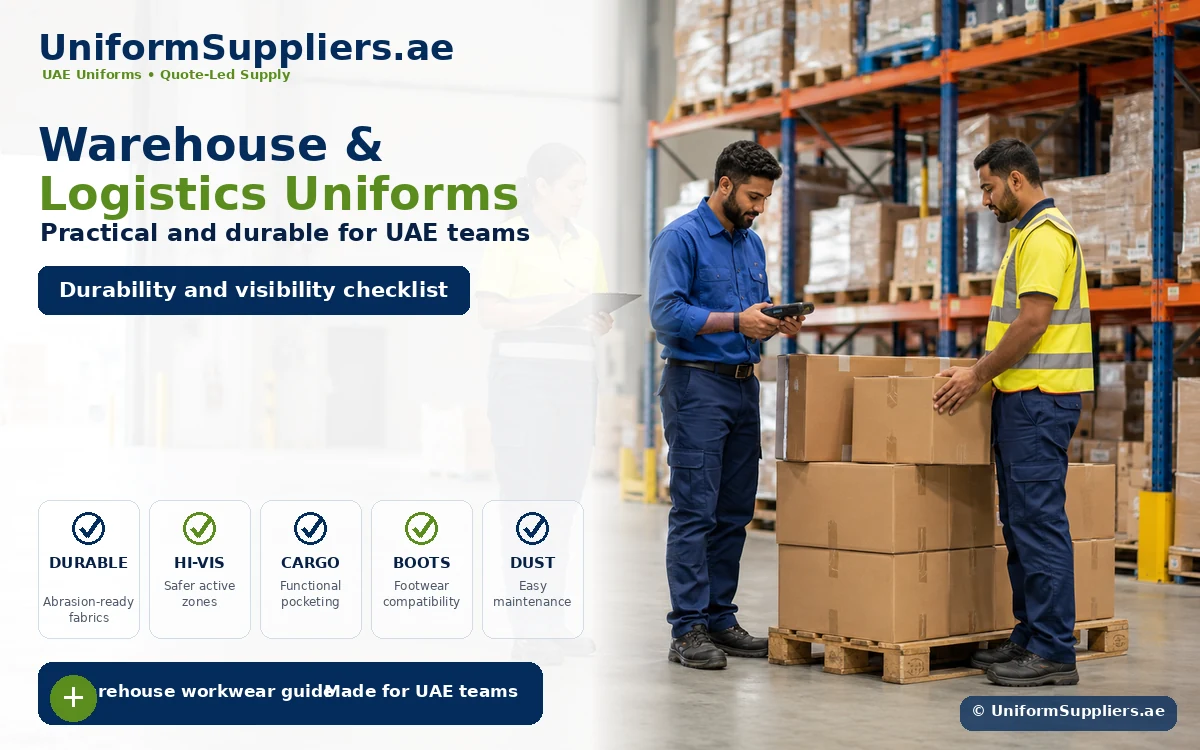
Warehousing in the UAE is rarely one working environment. A single distribution contract in Jebel Ali can involve an open yard above 45°C, a dusty dock apron, an ambient racking hall, a chilled room at 2°C and an air-conditioned dispatch office — often inside the same shift.
That range is why warehouse uniforms wear out faster here than procurement teams expect. A garment specified for a temperate distribution centre behaves differently under a high-visibility vest in August humidity, laundered four times a week and dragged past steel racking uprights for a year.
This guide sets out how to specify warehouse and logistics uniforms zone by zone, what to write into a tender about high-visibility clothing, and which details decide whether a garment survives a year.
What this guide covers
- Why UAE logistics sites are hard on workwear
- A zone-by-zone uniform table
- High-visibility clothing: what the classes mean
- Durability and identification checklist
- Cold chain and layering
- Drivers and the cab-to-dock problem
- Sizing, turnover and replacement planning
- Frequently asked questions
- Next step
Why UAE logistics sites are hard on workwear
The UAE logistics corridor runs from Jebel Ali and Dubai South through Al Quoz into the Sharjah industrial belt. Most of those facilities combine covered warehousing with open yards, and the yard is where the climate does its damage.
Between May and September, outdoor loading areas regularly sit above 42°C with high coastal humidity. Constant sweat saturation accelerates colour loss, weakens stitching thread and leaves salt residue in the fabric. These uniforms are washed far more often than office garments, and every extra cycle is a cost in the replacement budget.
Dust is the second factor. Yard dust and pallet debris settle into open weaves, abrade fabric from the inside and dull retroreflective tape, which performs nothing like tape out of the packet.
The third is people: high headcount, shift working and steady turnover mean the range must be simple enough to kit out a new starter on day one.
Finally, traffic. Forklifts, reach trucks and delivery vehicles share space with people on foot, so visibility here is not decoration — it is a control supporting pedestrian and vehicle separation. Our warehousing and logistics uniforms page sets out the range we build these programmes from.
A zone-by-zone uniform table
Treating a warehouse as one uniform zone is the most common specification error. A picker walking twelve kilometres a shift and a yard marshal in direct sun need different garments. Adjust the table below against your own risk assessment.
| Zone or role | Conditions | Core garments | Visibility requirement | Practical detail that matters |
|---|---|---|---|---|
| Inbound yard and dock | Direct sun, heat, dust, reversing vehicles | Long-sleeve shirt or polo, work trousers, hi-vis vest, cap | Highest on site; specify the class your risk assessment sets | Sun cover in a breathable, light-coloured fabric with underarm venting |
| Ambient racking and picking | Enclosed, warm, high step count, constant reaching | Breathable polo or T-shirt, work trousers, lightweight vest | Moderate; vest or hi-vis trim usually sufficient indoors | Shoulder movement, and a trouser rise that stays put when squatting |
| Forklift and MHE operators | Seated, indoor and outdoor, contact with controls | Close-fitting polo or shirt, trousers without catching pockets | Clear identification as an operator, plus hi-vis when on foot | Nothing loose to snag on levers; hi-vis that reads from the side |
| Chilled and frozen storage | 2°C to −25°C, short high-intensity spells | Base layer, insulated jacket or freezer suit, thermal gloves, headwear | Hi-vis on the outer layer only, so it is never hidden | Layers that come on and off in seconds, as staff move in and out |
| Packing and dispatch | Indoor, cooler, repetitive handling, paperwork | Polo or shirt, apron or tabard where needed | Low; site rules may still require a vest in shared aisles | Clean-looking cuffs and hems; pockets that hold a scanner without swinging |
| Last-mile drivers | Cool cab to hot bay, repeated, public contact | Smart polo or shirt, durable trousers, hi-vis vest in the cab | Hi-vis whenever on foot at a delivery point or in a yard | Crease recovery, so the driver still looks presentable at the door |
| Warehouse supervision | Moves between every zone, office and floor | Shirt or premium polo, trousers, distinct-colour hi-vis | Same standard as the floor, in a colour that identifies the role | A separate colour so a supervisor is findable across the hall |
High-visibility clothing: what the classes mean
High-visibility garments are commonly specified against EN ISO 20471, the international standard for high-visibility clothing. It classifies garments by the surface area of fluorescent background material and retroreflective material they carry.
Class 1 is the lowest coverage and suits low-risk, low-speed environments; Class 2 typically covers vests and tabards used around moving plant; Class 3 gives the greatest coverage, usually requiring sleeves, and is associated with roadside exposure. Fluorescent material gives daytime conspicuity; retroreflective tape works at night and in poorly lit bays.
Two points matter when buying. The class applies to the garment as worn, so a jacket left open or a vest under a rucksack will not deliver its tested coverage. And washing degrades both the dye and the tape, which is why ratings are tied to a stated number of cycles.
Write the required class into your tender and ask each supplier to confirm it on the datasheet and certificate, with the wash cycles the rating assumes. Uniform Suppliers UAE supplies hi-vis garments to the specification you set; certification sits with the manufacturer of the item, and we will not describe a garment as rated unless that documentation says so. See also our industrial workwear safety guide and the industrial uniforms and safety workwear pillar.
Durability and identification checklist
Most warehouse garments fail at a seam, a pocket, a fastening or a washed-out printed name rather than at the fabric. Run through this list before signing off a specification.
- Reinforced seams and knees. Double or triple stitching at the shoulder, crotch and side seams, plus knee reinforcement for staff at low pick faces.
- Pocket security when bending and climbing. Phones and scanners fall out of open hip pockets on ladders and mezzanine stairs. Specify a zipped or flapped pocket and test it bent forward, not standing still.
- Snag-free fastenings. Around racking uprights, cage trolleys and MHE controls, protruding zip pulls, drawcords and dangling lanyards are a catch risk. Choose covered closures and breakaway lanyards.
- Reflective placement. Tape must be visible from the side and rear, not only the front, because most forklift near-misses happen at aisle ends.
- Colour coding by shift, function or contractor. A simple scheme shows who is agency, who is contractor and who is MHE-trained. Three or four colours keeps it readable.
- Durable identification. Embroidery outlasts print on garments washed several times a week; individual identity is handled by badges, ID cards and lanyards.
- Fabric weight matched to the zone. Heavier cloth lasts longer but traps heat, so choose weight per zone. Our guide to fabric GSM in UAE workwear explains the trade-off.
- Wash cycle and replacement planning. Agree service life in wash cycles rather than months, record issue dates, and budget replacements quarterly.
Footwear sits outside the garment specification but inside the same risk picture; see safety shoes and boots for UAE worksites.
Cold chain and layering
Cold chain is the hardest zone to get right, because staff cycle between a freezer room and a warm dock across a shift. One heavy garment makes people overheat outside and chill when they sweat inside. Layering solves this: a moisture-managing base layer, an insulating mid layer and an outer freezer garment adjust in seconds. Keep hi-vis on the outer layer so it is never buried, and issue enough sets that a damp base layer is never worn into a freezer.
Drivers and the cab-to-dock problem
Drivers face the sharpest temperature swings in the operation: a cool cab, a 45°C loading bay, then a customer doorstep, dozens of times a day. Specify fabrics with good moisture management and crease recovery, because the driver is often the only team member a customer meets. Keep a hi-vis vest in every cab rather than relying on staff to carry one.
Sizing, turnover and replacement planning
Warehouse uniform programmes fail on logistics more often than on design. What matters is how fast a new starter is kitted out and how a damaged garment is replaced.
Start with accurate measurement rather than a size survey. Uniform Suppliers UAE provides free onsite individual measurements in the UAE for qualifying company uniform orders, and stores the specification records so repeat orders match. Employee-by-employee packing means each person receives a labelled set rather than a supervisor sorting a bulk carton.
Ready-stock supply alongside custom manufacturing usually works best: fast-moving polos and vests stay available for issue while branded items are produced. Set a written replacement trigger — faded hi-vis, failed tape, worn knees — so the decision does not sit with each supervisor.
Mustang recommendation
Build the programme in three tiers. Tier one is a common site polo in one breathable fabric across every zone, which protects identity and simplifies stockholding. Tier two is zone-specific: yard, MHE, cold store and driver variations. Tier three is identification — colour coding, embroidered role text and badges. Specify hi-vis class separately, in writing, and ask for the certificate before the first bulk order. Final specification will be confirmed during quotation.
Frequently asked questions
Should everyone in a UAE warehouse wear high-visibility clothing?
That depends on your risk assessment and site rules, but wherever pedestrians share space with forklifts, reach trucks or delivery vehicles, hi-vis is the normal control. Many operators apply one rule: it is worn by anyone stepping onto the floor or into the yard, visitors included.
What fabric works best for warehouse polos in the UAE summer?
Look for breathable, moisture-managing constructions in a mid weight that survives frequent laundering. Very light fabrics feel comfortable but split at the shoulder seam within months; heavy cotton holds sweat. Choose per zone, then trial the fabric on staff for a full shift before ordering in bulk.
How often should warehouse uniforms be replaced?
Plan in wash cycles rather than months, because a garment washed four times a week ages twice as fast as one washed twice. Use condition triggers instead of fixed dates: dulled tape, thinning knees, failed seams or logos that have lost definition. Budget a rolling replacement percentage each quarter.
Can we colour code uniforms by shift or contractor?
Yes, and it is one of the cheapest supervisory improvements available. Assign distinct colours to shifts, functions or contractors so responsibility is visible across a hall. Keep it to three or four colours and check each still meets the visibility requirement for its zone.
Do you supply certified high-visibility garments?
We supply high-visibility workwear to the specification a client sets, and ask the manufacturer for the datasheet and certificate covering the item supplied. Certification belongs to the garment manufacturer, not to us, so we will not describe an item as rated unless that documentation supports it. Tell us the class you need and we will source against it.
How do you handle sizing for a large warehouse team?
Onsite individual measurement is the most reliable method for a large team, particularly a multinational workforce where size charts vary by country of origin. Measurements are recorded per employee so reissues match. Our onsite measurement service covers the process.
Next step
If you are specifying uniforms for a warehouse, distribution centre or last-mile fleet, send us your zone list, headcount and the visibility class your risk assessment requires. We will return a garment recommendation and a costed proposal.
Request a quote for your warehouse and logistics uniform programme.