Special offers: free digital logo mock-up and free samples against a confirmed LPO. View offers
Aprons for Every Trade: Choosing the Right One

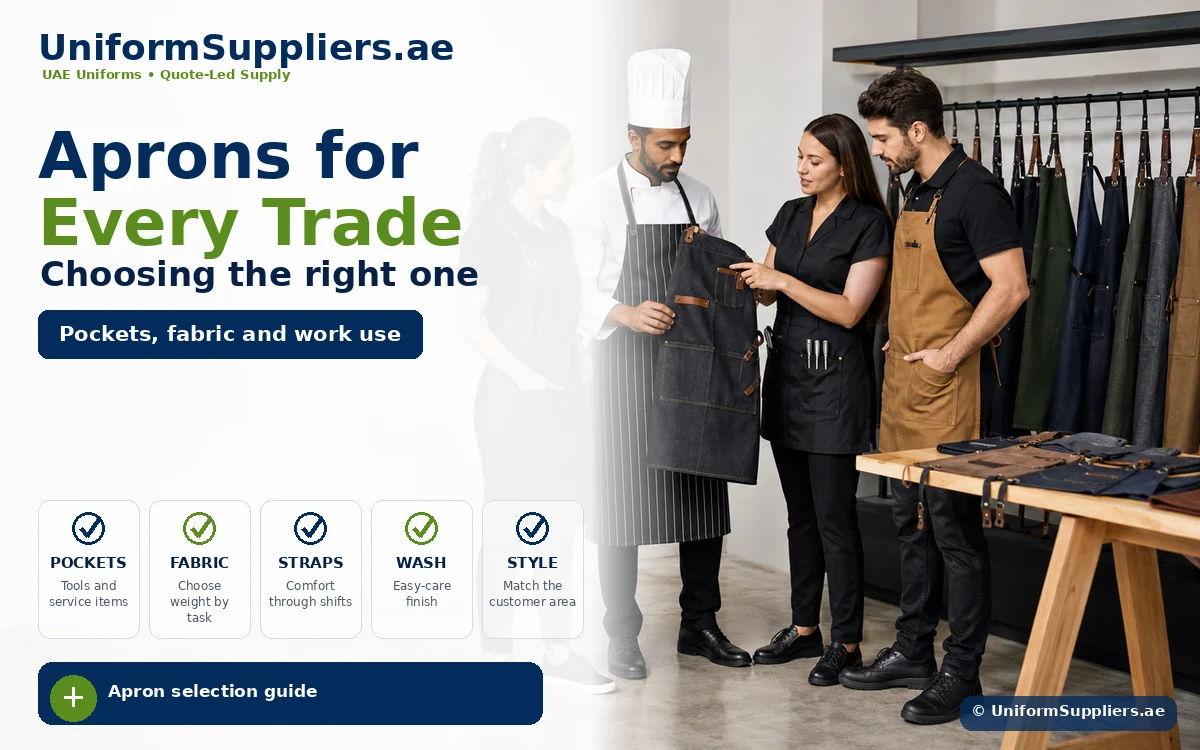
The apron is the most underestimated garment in a UAE uniform programme. It is the item staff put on first and take off last, the item that absorbs every spill, and — in a café, a bakery counter or a barber’s chair — often the only branded surface a customer studies at close range for several minutes.
It is also the item that gets replaced most often. Aprons take the heaviest stain load, the highest wash frequency and the roughest handling of anything in the wardrobe, so choosing the wrong style is a cost that repeats every few months.
This guide covers the main apron styles, the trades each one suits, the fabric and weight decisions that matter in a hot kitchen, and a specification checklist you can send with an enquiry. Chef jackets and full kitchen wardrobes are covered separately in our chef wear and kitchen uniforms guide.
What this guide covers
- Why the apron carries more weight than its price suggests
- Apron styles and the trades they suit
- Fabric and weight for UAE conditions
- The specification checklist
- Branding that survives the wash
- Wash load, quantities and replacement
- Your next step
- Frequently asked questions
Why the apron carries more weight than its price suggests
Three things make the apron a decision rather than an afterthought.
Comfort. UAE kitchens run hot even with air conditioning working properly, because the heat source is inside the room. A heavy apron over a chef jacket or a shirt adds a layer across the torso for an entire shift. Weight and coverage are therefore comfort decisions, not just protection decisions.
Load on the body. A conventional neck strap hangs the whole apron, plus whatever is in the pockets, from the back of the neck. Over an eight or ten hour shift that becomes a genuine complaint, which is why cross-back styles have moved from speciality coffee into mainstream hospitality across Dubai and Abu Dhabi.
Visibility. A guest reads a barista’s apron for the length of the order. As our guide to restaurant staff uniforms sets out, the apron is prime brand real estate and should be treated as such.
Apron styles and the trades they suit
Use this table to shortlist. Most operations end up with two or three styles rather than one, because coverage needs differ between the pass, the floor and the back door.
| Apron style | Coverage | Typical fabric | Best trades | Detail that matters |
|---|---|---|---|---|
| Bib apron | Chest to knee or mid-calf | Poly-cotton twill or drill | Kitchen, catering, cafés, food production | Adjustable neck strap and a wide enough bib to protect the shirt front |
| Cross-back apron | Chest to knee | Cotton canvas, denim or heavy twill | Speciality coffee, bakeries, casual dining, florists | Load spreads across both shoulders; no buckle to adjust once fitted, so sizing matters |
| Waist or half apron | Waist to mid-thigh | Lightweight poly-cotton | Waiters, bar staff, quick-service counters | Pocket depth and position for a card machine and pad |
| Bistro (long waist) apron | Waist to below knee | Poly-cotton, canvas | Casual and fine dining, bar service, buffet lines | Length must clear the floor and stairs; long ties for a front knot |
| Four-way waiter apron | Waist to thigh, four usable faces | Poly-cotton | Busy service floors, banquets, events | Rotates to a clean face mid-service instead of a change of apron |
| Barber and stylist apron | Chest to knee, often water-repellent | Coated polyester, treated canvas | Barbershops, salons, spas, grooming | Hair and chemical shedding; slim cut so it does not catch on the chair |
| Butcher or heavy-duty apron | Chest to below knee, full width | Heavy drill, canvas, PVC or coated fabric | Butchery, fishmongers, dishwash, central kitchens, cleaning | Wipe-clean surface and reinforced stress points; comfort drops as weight rises |
| Disposable or wipe-clean | Chest to knee | Polythene or non-woven | Food handling, catering events, clinical and lab support | Single-shift use; keep for hygiene-critical or visitor tasks, not daily wear |
Mustang recommendation: in a mixed hospitality operation, specify a cross-back bib for anyone standing through a long shift, a bistro or four-way waist apron for service staff who need speed and a clean face, and a heavy-duty apron kept at the wash-up and delivery points rather than issued personally.
Fabric and weight for UAE conditions
Fabric choice is a balance between protection, breathability and how the apron behaves after repeated commercial laundering.
- Poly-cotton twill. The default for food service. It resists creasing, releases stains reasonably well and dries quickly, which matters when aprons are washed daily.
- Cotton canvas and denim. Heavier and more characterful, popular for speciality coffee and artisan bakeries. Softens attractively with washing but holds heat and takes longer to dry.
- Coated or laminated fabrics. Necessary where liquid contact is constant — dishwash, butchery, cleaning. Not breathable, so restrict them to the tasks that need them.
- Weight. Lighter cloth is more comfortable in a hot kitchen; heavier cloth lasts longer and hangs better. State a target GSM on the enquiry rather than asking for “good quality”.
Colour is a durability decision too. Dark aprons hide stains but show flour, sugar and bleach spotting badly; light aprons look clean but need higher-quality dyeing to survive the wash cycle. Ask your supplier to confirm colourfastness performance on the product datasheet before standardising on a shade.
The specification checklist
Work through these points before you request pricing. Each one is a common cause of complaint after issue.
- Neck strap or cross-back. Decide where the load sits. Neck straps suit shorter shifts and shared aprons; cross-back suits long standing shifts and personally issued garments.
- Adjustable buckles. A sliding metal or plastic buckle on the neck strap lets one apron fit a wide range of heights, which matters on a multinational team.
- Tie length and knot position. Confirm whether ties should knot at the back or wrap to the front. Front-tied aprons need noticeably longer ties, and this is routinely missed on first orders.
- Pocket count and depth. Specify what actually goes in them: order pad, two pens, a probe thermometer, a card machine, service cloth. Shallow pockets shed pens all shift.
- Stitch reinforcement. Ask for bar-tacking at pocket corners, strap joints and tie anchor points. These are the failure points on almost every worn-out apron.
- Hem weight and finish. A double-turned or weighted hem keeps a long apron hanging straight instead of curling after washing.
- Colourfastness. Aprons meet bleach, sanitiser, tomato, turmeric and citrus. Confirm the fabric’s wash temperature and colourfastness rating rather than assuming.
- Branding placement. Fix the position, size and method now, and check it does not sit where a waist tie or pocket edge will abrade it.
- Size and length range. Order at least two lengths where staff heights vary widely; a bistro apron that fits one person at the knee will trail on another.
Final specification will be confirmed during quotation.
Branding that survives the wash
Aprons are washed more often and hotter than almost any other uniform item, so the branding method has to be chosen for that cycle rather than for appearance alone.
Embroidery is the most durable option on twill, canvas and denim, and it reads as a quality signal at close range. It suits logos with clear shapes and a limited colour count. On very heavy or coated fabrics, confirm with your supplier that the material takes embroidery cleanly.
Screen printing suits larger artwork and full-colour marks, and is the practical choice for promotional or short-run aprons. Heat transfer works well for names or site labels. Whichever method you choose, keep the logo clear of the chest fold, the waist tie line and the pocket mouth, where abrasion concentrates.
A free digital logo mock-up is available so you can see placement and scale on the actual apron style before anything is produced.
Wash load, quantities and replacement
Aprons are consumables in a way that shirts and trousers are not. Plan the quantity around the wash cycle, not the headcount.
A kitchen or café apron typically changes at least once per shift. Every apron in the wash is an apron not on the floor, so a per-person allocation that ignores laundry turnaround leaves staff short by the second week.
Build the order from three numbers: staff on shift, apron changes per shift, and laundry turnaround in shifts. Add a small buffer for new joiners and for the aprons that inevitably leave the building. Because the item is replaced frequently, many operations run aprons on ready stock while keeping bespoke garments for the roles that define the brand — the trade-off is set out in our guide to ready-stock versus custom uniforms.
Aprons also cross departments. Housekeeping, spa reception and treatment rooms use lighter styles with different pocket needs — see spa and salon uniforms — while a hotel will run several apron specifications across restaurant and catering outlets under one brand standard.
Your next step
The fastest way to settle an apron specification is to handle the fabric and try the fit. Free samples are available against a confirmed LPO, and we can supply more than one style side by side so your team can compare weight, pocket depth and strap comfort during a real shift.
Request a Sample, or send your outlet list and staff numbers to request a quote. Wider wardrobe planning is covered on our hospitality uniforms UAE page.
Frequently asked questions
Cross-back or neck strap — which should we choose?
Choose cross-back where staff stand for long shifts, carry weight in the pockets or complain of neck and shoulder fatigue, since the load spreads across both shoulders. Choose an adjustable neck strap where aprons are shared between staff of different heights or worn for shorter periods, because the buckle allows quick adjustment. Many operations run both, split by department.
What apron length works best for waiting staff?
A bistro apron that finishes just below the knee is the common choice for full-service dining, while a shorter waist apron suits quick service and bar work where speed matters more than coverage. Length should clear stairs and service steps. Where staff heights vary widely, order two lengths rather than forcing one size to work for everyone.
How many pockets should an apron have?
Specify pockets by contents rather than by number. Waiting staff usually need a divided front pocket for a pad, two pens and a card machine. Kitchen staff often need a narrow pocket sized for a probe thermometer. Baristas frequently prefer a single towel loop and one shallow pocket. More pockets add weight and sag, so only specify what is used.
Can aprons match our brand colour exactly?
Stock apron ranges cover a wide colour card, and for most operations a close catalogue shade is acceptable. If the apron is a primary brand surface and must match an exact reference, that is a custom manufacturing decision, made alongside fabric weight, pocket layout and strap style. Both routes can be quoted together within one uniform programme.
Are disposable aprons worth using in a UAE kitchen?
They earn their place in hygiene-critical, short-duration tasks — raw preparation, allergen handling, visitor access and cleaning. They are not a substitute for daily wear: they are uncomfortable in a hot kitchen, carry no branding value and generate continuous waste. Keep a boxed supply for specific tasks alongside a laundered apron set.
How often should aprons be replaced?
Replace on condition rather than on a fixed calendar. The usual triggers are visible staining that will not lift, fading against the rest of the wardrobe, frayed ties, failed pocket corners and a hem that no longer hangs straight. Because aprons are laundered far more frequently than other items, most operations plan a replenishment review well ahead of the rest of the uniform programme.