Special offers: free digital logo mock-up and free samples against a confirmed LPO. View offers
Embroidery vs Screen Printing: Quick Comparison

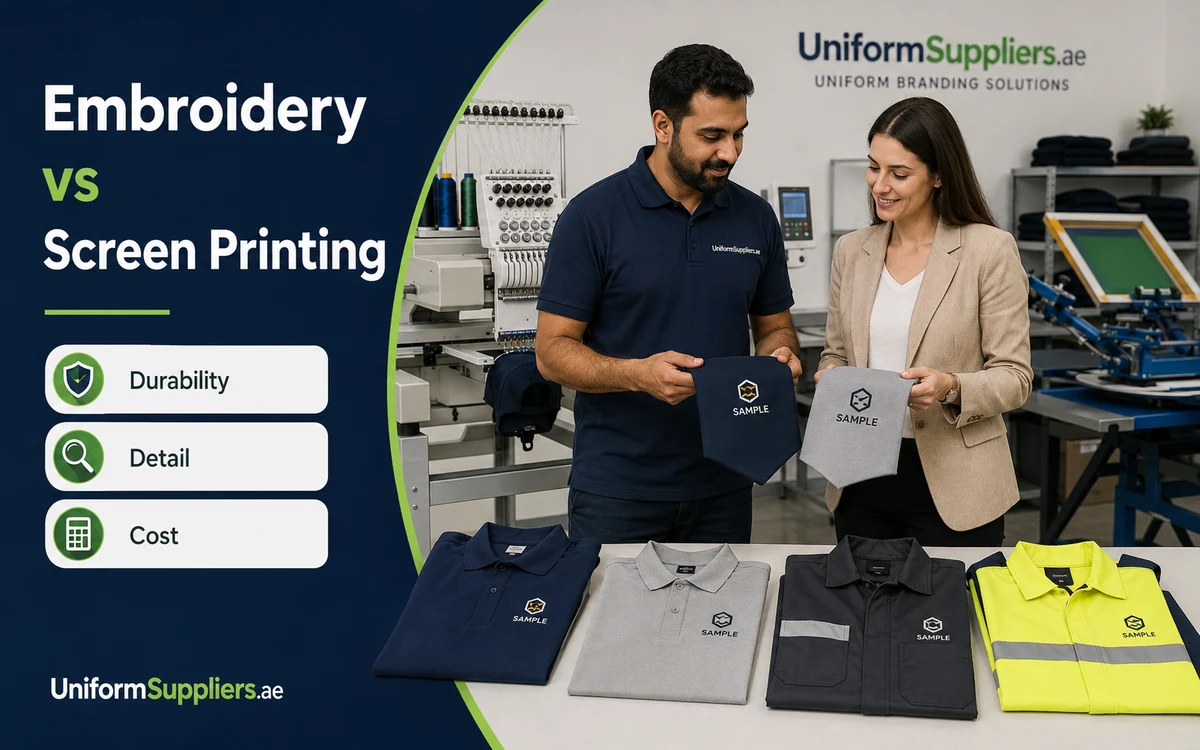
Embroidery and screen printing are the two branding methods most uniform buyers end up choosing between. Both brand uniforms well, but each suits different designs, fabrics and budgets, and the wrong choice shows quickly: a stiff patch on a thin shirt, or a print that cracks after hot washes.
This is the quick two-method comparison. It covers embroidery vs screen printing across six factors, then gives a garment-by-garment decision table. For heat transfer, sublimation and badges as well, see our fuller embroidery vs printing guide.
What this guide covers
- Embroidery vs screen printing at a glance
- Durability in laundering
- Look and perceived quality
- Fabric suitability
- Logo detail and colour count
- Small runs and large runs
- Placement on the garment
- Decision table by garment
- Buyer checklist
- Frequently asked questions
Embroidery vs screen printing at a glance
| Factor | Embroidery | Screen printing |
|---|---|---|
| How it works | Thread stitched through the fabric, following a digitised stitch file | Ink pushed through a mesh screen onto the fabric surface, one screen per colour |
| Look | Raised, textured, formal | Flat, smooth, graphic |
| Durability in laundering | Very durable; withstands frequent washing | Durable when ink and fabric are matched and care labels are followed |
| Fabric suitability | Medium and heavier fabrics; thin or stretchy fabrics need backing | Smooth, stable fabrics; textured or coated fabrics need testing |
| Logo detail | Clean on bold shapes; very small text and gradients are difficult | Sharp edges at larger sizes; each extra colour adds a screen |
| Run size | One-off stitch file, then effort per piece depends on stitch count | Set-up per colour and per design, so it suits larger runs of one design |
| Typical placement | Chest, sleeve, collar, cap front | Chest, full back, large front graphics |
Durability in laundering
Uniforms in the UAE are washed often, and many go through commercial laundries at higher temperatures than home machines. Embroidery copes well: the thread is locked through the fabric and withstands frequent washing. Its weak points are mechanical, such as threads snagged on hook-and-loop fasteners or abraded on rough surfaces.
Screen prints sit on the fabric surface. A properly cured print on a suitable fabric lasts well, but repeated hot washing, strong detergents, tumble drying and ironing directly over the print shorten its life. If garments go to a commercial laundry, say so when you brief the supplier. Our fabric care guide covers washing branded garments.
Look and perceived quality
Embroidery reads as premium and permanent, which is why it is the usual choice for customer-facing roles in offices, hotels and clinics. The raised texture gives even a small logo presence on a polo or shirt.
Screen printing reads as graphic and modern. It suits bold statements such as a large back print on a crew T-shirt, a campaign slogan or a department name that must be read from a distance. Neither is better in absolute terms. The question is what the role needs to communicate.
Fabric suitability
Embroidery needs a fabric with enough body to support the stitches. Piqué polos, twill shirts, drill coveralls, fleece and caps take it well. Lightweight shirting and stretchy performance knits can pucker around dense stitching unless the design is lightened and the fabric backed. On waterproof or coated jackets, needle holes can let water through.
Screen printing prefers a smooth, stable surface. Cotton and cotton-rich jerseys print readily. Polyester and coated fabrics need inks chosen for them, and heavily textured fabrics break up fine detail. Our earlier article on choosing the right branding method for your fabric goes deeper. Final specification will be confirmed during quotation.
Logo detail and colour count
Thread has thickness, so embroidery has a minimum workable size for letters and lines. Bold logos and short names stitch cleanly. Taglines in small type, thin outlines and colour gradients usually need simplifying. Colour count matters less, because changing thread colour is routine.
Screen printing holds sharp edges and handles large solid areas well. Each colour needs its own screen, so a one-colour or two-colour version of the logo is simpler to produce than a full-colour one. Gradients and photographic artwork are possible but are often better handled by other print methods, explained in our garment branding methods FAQ.
Small runs and large runs
Exact costs depend on the design and are set out in your quotation, so this section explains only how each method scales. With embroidery, the logo is digitised once and the stitch file is reused for every later order. After that, the effort per garment depends mainly on stitch count, so the method works for a few new-joiner kits as well as a full rollout.
With screen printing, screens are prepared for each colour of each design before the first garment is printed. That preparation is spread more efficiently across a large run of one design, which is why printing is favoured for big batches of event and promotional T-shirts. For a small number of garments with a multi-colour design, embroidery or another print method is often more practical.
Placement on the garment
Embroidery suits compact positions: left or right chest, sleeve, the back yoke below the collar, and cap fronts. Large embroidered backs are heavy and warm, so they are rarely chosen for outdoor roles. Avoid stitching over seams, pen pockets and reflective tape.
Screen printing suits large areas: full back, centre front and sleeve prints. It needs a flat surface, so positions across zips, seams and pockets are best avoided. A common combination is an embroidered chest logo with a printed back.
Decision table by garment
| Garment | Usual choice | Why | When to switch |
|---|---|---|---|
| Polo shirt | Embroidery | Piqué supports stitching and the logo stays smart after many washes | Large back graphic: add a print |
| Corporate shirt | Embroidery, small and light | Formal look; keep stitch density low on fine shirting | Very fine fabric: consider a name badge instead |
| T-shirt | Screen printing | Smooth jersey prints well and suits large designs | Small chest logo on a heavier T-shirt: embroidery works |
| Coverall | Embroidery on the chest, print on the back | Chest logo survives harsh washing; back print is readable at a distance | Protective garments: follow the garment manufacturer’s guidance |
| Hi-vis vest | Screen printing | Light mesh and thin polyester do not support dense stitching | Keep branding clear of reflective tape in every case |
| Cap | Embroidery | Structured front panels hold stitching well | Soft, unstructured caps: keep the design small |
| Apron | Embroidery | Withstands frequent hot washing in kitchens and cafés | Large promotional design: print |
| Jacket | Embroidery | Fleece, softshell and blazers suit a stitched logo | Waterproof shells: avoid needle holes and ask about print options |
Related ranges: corporate polo shirts, promotional T-shirts, high-visibility clothing and branded caps.
Mustang recommendation: for uniforms worn and washed every week, embroider the logo at chest size and reserve screen printing for large back prints, event T-shirts and hi-vis. If your logo has small text, ask for a simplified embroidery version and approve it as a separate brand asset. We can combine methods across your order, and we provide a free digital logo mock-up before production so you can check size and position on each garment.
Buyer checklist
- List each garment with its fabric and colour.
- Decide the logo position and approximate size per garment.
- Count the colours in your logo and check whether a one-colour version exists.
- Check the smallest text in the logo and whether it can be dropped for embroidery.
- Tell the supplier how garments are laundered.
- Flag hi-vis, flame-resistant and waterproof garments for separate advice.
- Approve the digital mock-up, and a sample where needed, before production.
Upload your logo for a free digital mock-up
Send your logo and garment list through Request a Quote and we will suggest embroidery, screen printing or a combination for each item. Read more about our embroidery and garment printing services, or request a sample; free uniform samples are provided against a confirmed Local Purchase Order (LPO). Corporate teams can see how branding fits a full range on our corporate uniforms page.
Frequently asked questions
Is embroidery more durable than screen printing?
In general, yes. Embroidery withstands frequent washing and usually lasts as long as the garment. A well-made screen print is also durable, but it is more sensitive to hot washing, tumble drying and ironing over the print.
Which is better for polo shirts?
Embroidery is the usual choice for a chest logo on a piqué polo, because the fabric supports stitching and the result looks smart. Printing is added when a large back design is needed. Our article on polo shirts for business covers fabric and fit.
Can a detailed logo be embroidered?
Often, but very small text, thin lines and gradients may need simplifying. We show the proposed version on a digital mock-up before production so you can approve it.
Which method suits a large order of T-shirts?
Screen printing is normally favoured for large runs of one design on T-shirts, particularly with large front or back graphics. Tell us the number of colours in the design when you request a quote.
Can both methods be used on the same garment?
Yes. An embroidered chest logo with a screen-printed back is a common combination on coveralls, crew polos and jackets. Our branding methods page summarises the options.
Will repeat orders match the first batch?
We keep stored records of the approved logo position, branding, colour and fabric, and the embroidery stitch file is reused, so repeat orders and new-joiner kits follow the same approved reference.